
The Early History of U.S. Hospital-Based Helicopter EMS
Modern hospital-based helicopter EMS did not appear all at once. It developed through private helicopter-ambulance experiments, regional EMS systems, hospital-sponsored programs, aviation contractors, and evolving models of critical-care transport.
This RotorPedia project began with a deceptively simple question. Contemporary accounts associated with two Pennsylvania programs described Allentown & Sacred Heart MedEvac as the nation’s “31st” program, while a later Geisinger retrospective described Geisinger Life Flight as the “28th.” MedEvac began transporting patients in May 1981, while Geisinger formally entered service on July 1 of that year. How were those rankings determined—and which earlier programs were being counted?
Trying to answer that question led to a much larger investigation. RotorPedia began reconstructing the development of helicopter EMS in the United States program by program, using contemporary newspapers, historical publications, photographs, aircraft records, institutional histories, and other primary and near-primary sources. The research revealed that defining when a program actually “began” is not always straightforward. A service might have a demonstration flight, receive its helicopter, transport its first patient, begin limited operations, or hold a formal dedication on different dates.
It also became clear that there was no single definition of what constituted a hospital-based helicopter EMS program during this formative period. Some early services were directly sponsored by hospitals, while others were cooperative hospital systems, regional EMS operations, private helicopter ambulances, or programs operated through aviation contractors. Different definitions could therefore produce different national counts.
This is a historical reconstruction, not a national ranking. RotorPedia preserves contemporary claims such as “28th” and “31st” because they are valuable pieces of the historical record. Rather than assuming those numbers were either correct or incorrect, this project attempts to understand how such rankings may have been constructed while independently documenting the programs that preceded them.
Where sources disagree—or where an exact launch date, aircraft registration, aviation operator, or historical claim remains uncertain—the differences are identified rather than assumed.
How to Read This Chronology
Program dates can represent different milestones—including a first patient flight, operational start, formal dedication, or an earlier demonstration or developmental flight. When evidence supports more than one milestone, those dates are preserved and identified separately.
Aircraft registrations are identified according to the strength of the available evidence. Some are confirmed by contemporary photographs or records, while others remain strongly supported, probable, candidate, or unresolved.
RESEARCH KEY
Confirmed: Supported by strong contemporary evidence
Strongly Supported: Multiple sources point to the same conclusion
Probable Candidate: Evidence is promising but not conclusive
Unresolved: Additional evidence is still needed
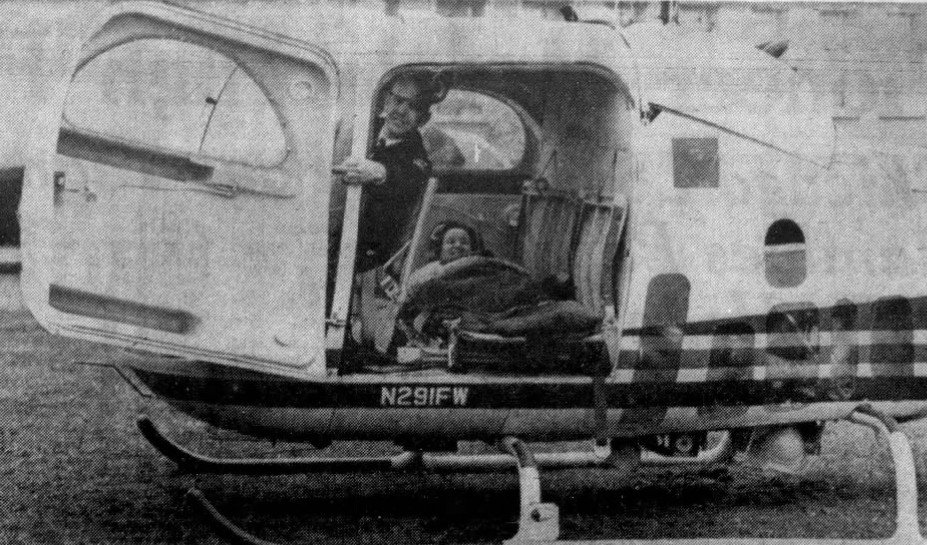
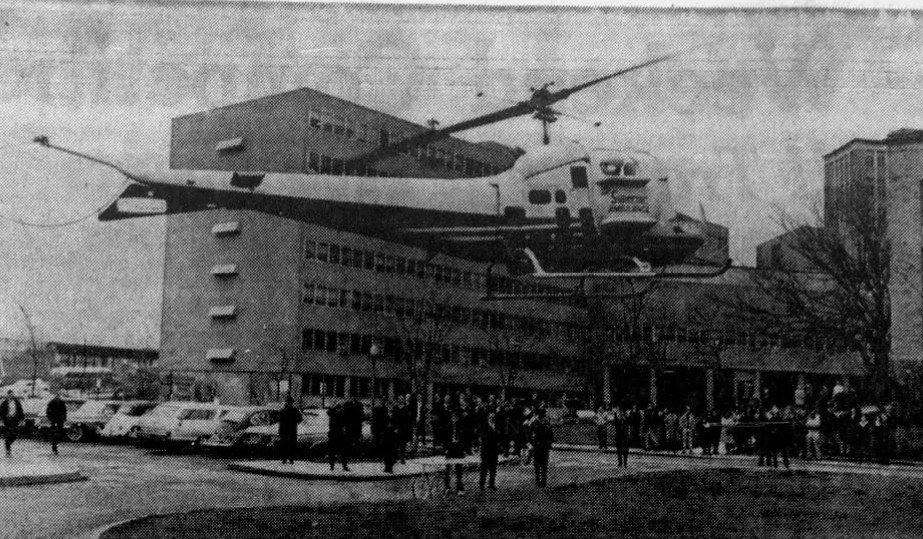
Superior Ambulance Service — 1967
Bell 47J Ranger N291FW during a demonstration of Superior’s helicopter ambulance service.
The Ann Arbor News, December 7, 1967, p. 29
1967 — Superior Ambulance Service: An Early Precursor
In 1967, Superior Ambulance Co. of Wyandotte, Michigan, developed an experimental helicopter ambulance service that represents an important precursor to the hospital-based helicopter EMS programs that would follow in the 1970s.
Superior used a Bell 47J Ranger configured to transport patients by air. On December 7, 1967, the company demonstrated and tested its helicopter ambulance concept. Contemporary photographs from the demonstration show Bell 47J N291FW and illustrate the aircraft’s patient-carrying configuration.
Just eight days later, on December 15, 1967, Superior conducted its first documented emergency patient transport. Lester Woodard of Garden City, who had suffered severe burns at his home, was initially transported to Wayne County General Hospital. Superior then flew him by helicopter to University Hospital in Ann Arbor.
The helicopter completed the hospital-to-hospital flight in approximately 15 minutes, landing at University Hospital at 4:07 p.m. Contemporary reporting identified Woodard as the first patient transported by helicopter to University Hospital.
The aircraft was capable of carrying two stretcher patients along with a pilot and attendant. Superior also held an ambulance-service contract with Washtenaw County and expected to use the helicopter when circumstances warranted.
Aircraft: Bell 47J Ranger N291FW is photographically confirmed with Superior Ambulance Service during the December 7, 1967 demonstration. RotorPedia has not yet found evidence establishing that N291FW was specifically the aircraft used for the December 15 Woodard mission.
Historical context: Superior was a private ambulance company rather than a hospital-sponsored helicopter program. RotorPedia therefore treats Superior as an important early civilian helicopter-ambulance precursor, separate from the hospital-based HEMS chronology that emerged during the following decade.
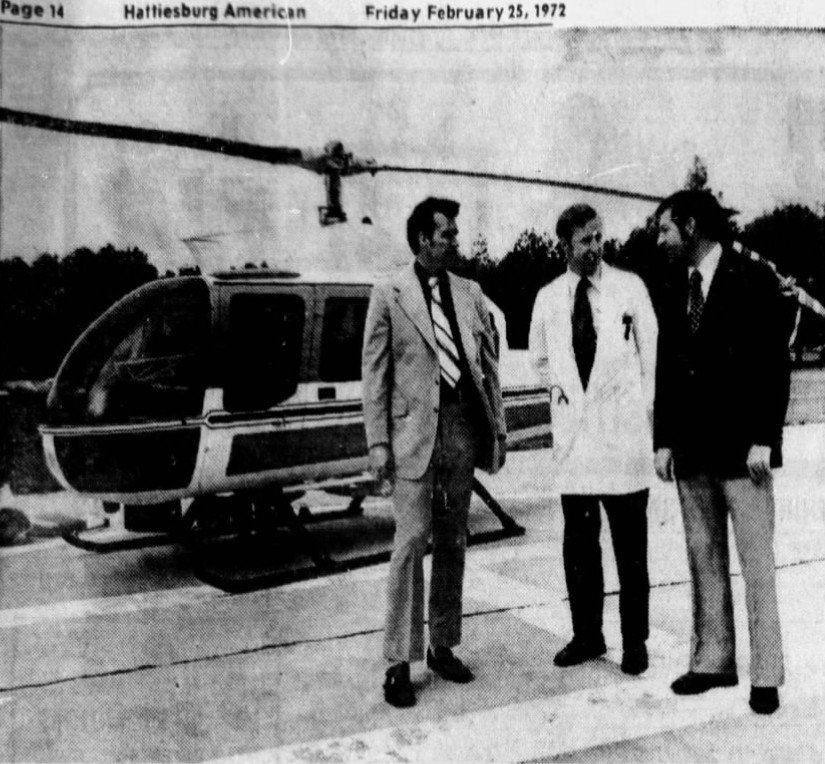
Resue 7 / SEMAAD | 1972
Hattiesburg American, February 25, 1972, p. 14
1972 — Rescue 7 / SEMAAD: A Regional EMS Model
Southeast Mississippi Air Ambulance District — Hattiesburg, Mississippi
Rescue 7 / SEMAAD began helicopter medical operations on March 9, 1972, serving a five-county region of southeast Mississippi.
The program used a Fairchild-Hiller FH-1100 and represented a different model from the hospital-sponsored helicopter programs that were beginning to emerge during the same period.
SEMAAD had been organized in 1971. Its original helicopter was destroyed during a December 22, 1971 test flight, and FAA certification for a replacement aircraft was received on March 8, 1972, clearing the way for patient operations to begin the following day.
Early pilots included Fred Forbey and Bobby Lott. By July 1972, the service reportedly had completed 120 missions involving 91 patients.
Historical context: Rescue 7 was a community/regional EMS helicopter system rather than a conventional hospital-sponsored HEMS program. RotorPedia includes it because it was an important part of the development of civilian helicopter EMS.
Research note: The registration of the replacement FH-1100 used at the March 1972 launch remains unresolved.
From Ambulance Helicopters to Hospital-Based HEMS
Superior Ambulance Service and Rescue 7 demonstrated that civilian helicopters could be used to move emergency patients, but the hospital-based model that emerged during the 1970s would be different. Hospitals increasingly became the center of the medical operation, while specialized aviation companies supplied aircraft, pilots, maintenance, and aviation expertise. This partnership between hospitals and helicopter operators would become one of the defining features of early American HEMS.
1972 — The Hospital-Based Model Emerges
Loma Linda University Medical Center — California
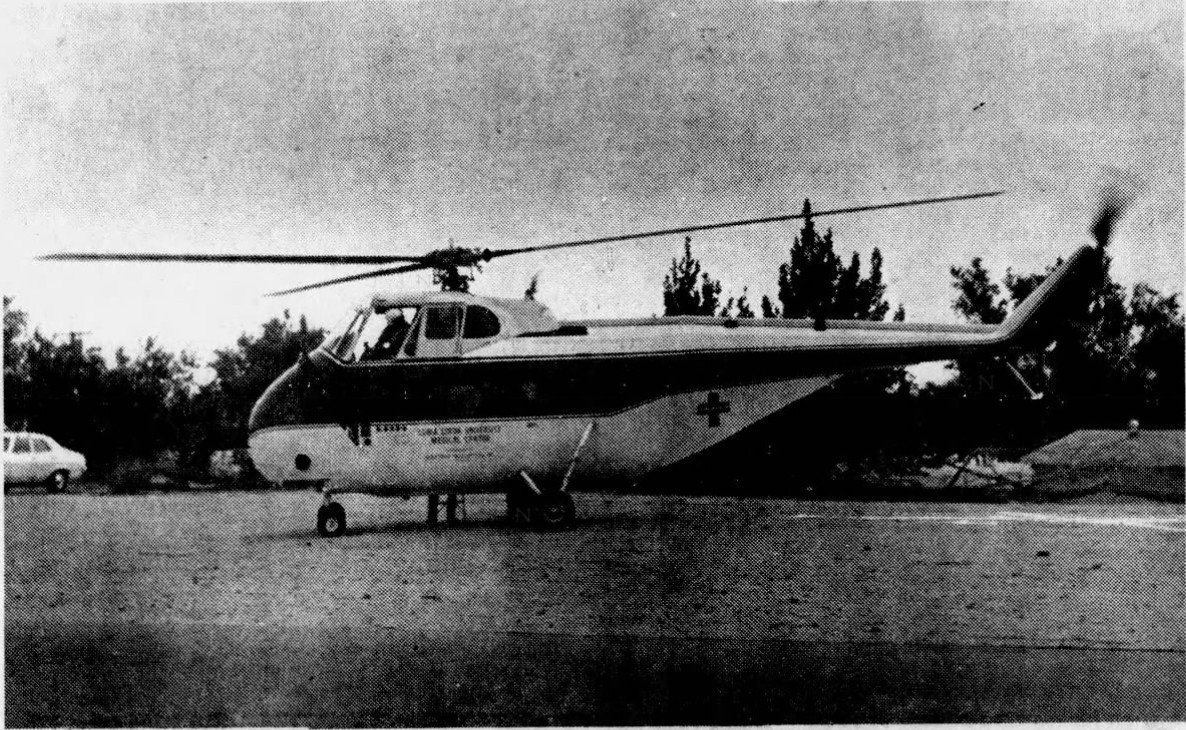
Loma Linda had already been experimenting with helicopter patient transport before 1972. Its rooftop heliport was dedicated in 1969, and a helicopter transported a medevac patient to the hospital that December. After additional experimentation, a permanent hospital-sponsored helicopter service began on June 5, 1972, using a Sikorsky S-55/H-19 operated through Western Helicopters.
St. Anthony Hospital — Denver, Colorado
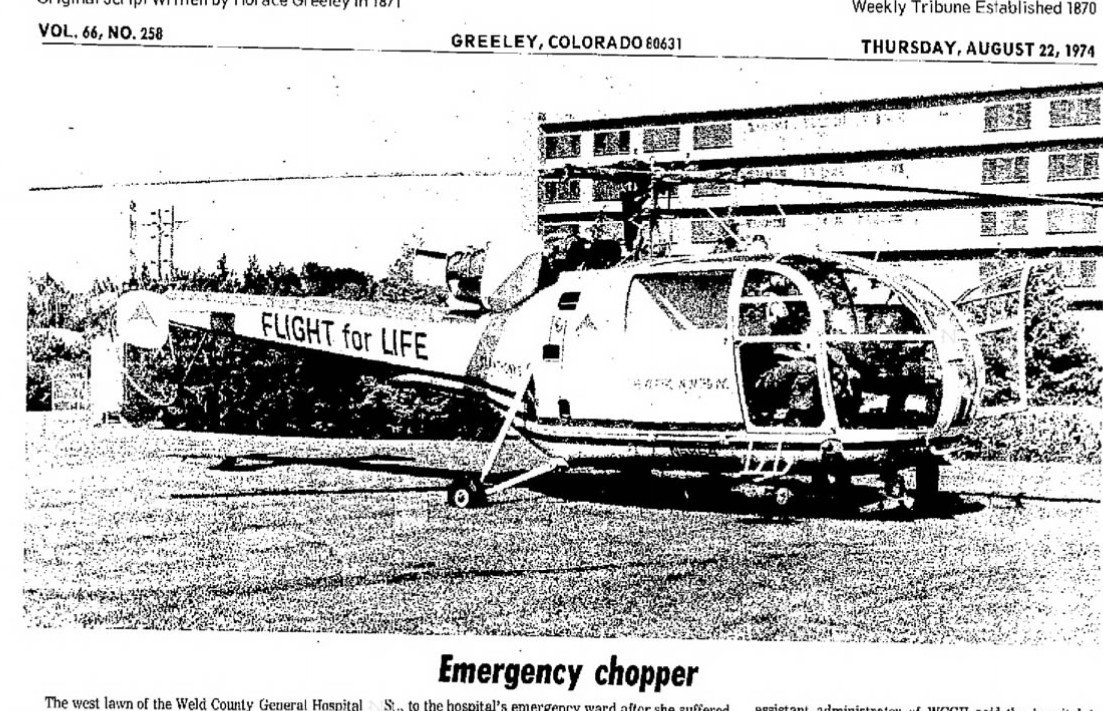
Later that year, St. Anthony Hospital launched Flight For Life on October 12, 1972, using an Alouette III. St. Anthony became one of the foundational programs in the development of the modern hospital-sponsored HEMS model.
Historical images:
Loma Linda University Medical Center — Desert Dispatch, June 3, 1972
St. Anthony Flight For Life — Greeley Daily Tribune, August 22, 1974
1975 — ALERT: An Early Rural HEMS Model
ALERT — Kalispell, Montana
On September 25, 1975, ALERT—Advanced Life-support Emergency Rescue Team—made its first official flight from Kalispell, Montana. The program represented an important early example of bringing advanced helicopter medical transport to a largely rural region.
Early figures included pilot Ted Parod and physician Dr. Van Kirke Nelson. Aviation support was provided by Mountain West Helicopters, associated with Parod and Hank Galpin.
A Bell 206B JetRanger II, N49634, is documented with Mountain West by October 1975 and is strongly associated with the early ALERT operation. However, current evidence does not yet prove that N49634 flew the September 25 inaugural mission.
Historical note: Later accounts have described ALERT as the second hospital-based advanced-life-support helicopter system after Denver. RotorPedia preserves this as a historical claim rather than assigning it a verified national rank.
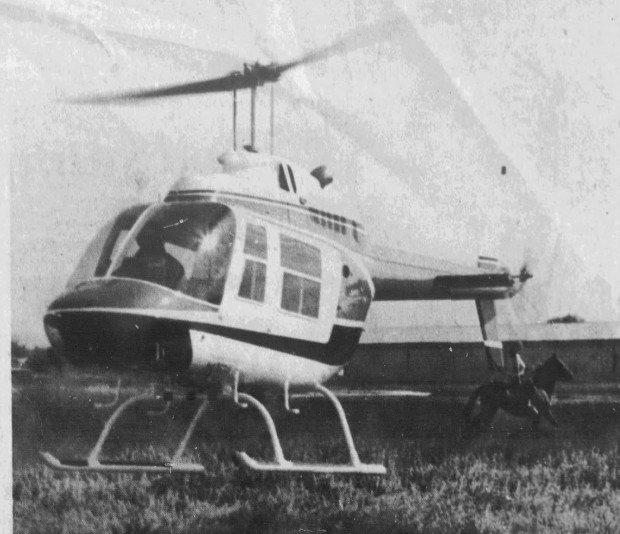
ALERT helicopter
The Daily Inter Lake, October 5, 1972, p. 12
AVIATION OPERATOR SPOTLIGHT
Rocky Mountain Helicopters became one of the most influential aviation operators in the early expansion of hospital-based helicopter EMS. The company provided aircraft, pilots, maintenance, and aviation expertise while hospitals supplied the medical crews and clinical direction.
Through its Aviation Medical Services operation, Rocky Mountain helped develop and support hospital helicopter programs across the United States during the late 1970s. Its involvement connected several of the pioneering programs documented in this chronology, including Hermann Life Flight, Baptist Life Flight, and Emanuel Life Flight.
This partnership model—a hospital medical program paired with a specialized commercial helicopter operator—would become a defining feature of the rapid growth of American HEMS.

1976 — Hermann Life Flight
Hermann Life Flight – Houston, Texas
On August 1, 1976, Hermann Hospital launched Life Flight with an SA319B Alouette III, N90825, operated by Rocky Mountain Helicopters. Its first emergency call came that morning following a house fire involving Louis and Sadie Oliver. Louis Oliver was flown from Houston Citizens General Hospital to Hermann Hospital, while Sadie Oliver was subsequently transported from Hermann to John Sealy Hospital in Galveston.
Contemporary reporting: The Houston Post reported the following day that the first flight to Hermann took five minutes compared with an estimated 15 minutes by ground ambulance, while the Hermann-to-Galveston flight took 22 minutes compared with an estimated 45 minutes by ground. The newspaper described Life Flight at the time as “only the third of its kind” offered by a civilian hospital in the United States. RotorPedia preserves this as a contemporary historical claim rather than a verified national ranking.
The medical model combined hospital-based critical care expertise with aviation services provided by a specialized helicopter operator. Early Life Flight crews included a physician and flight nurse.
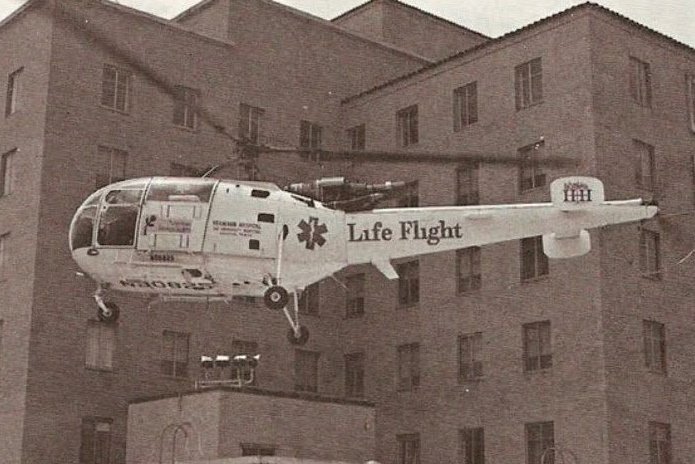
Hermann Life Flight | 1976
Historic image courtesy of Hermann Memorial / Texas Trauma Institute
1977 — Baptist Life Flight
Baptist Hospital – Pensacola , Florida
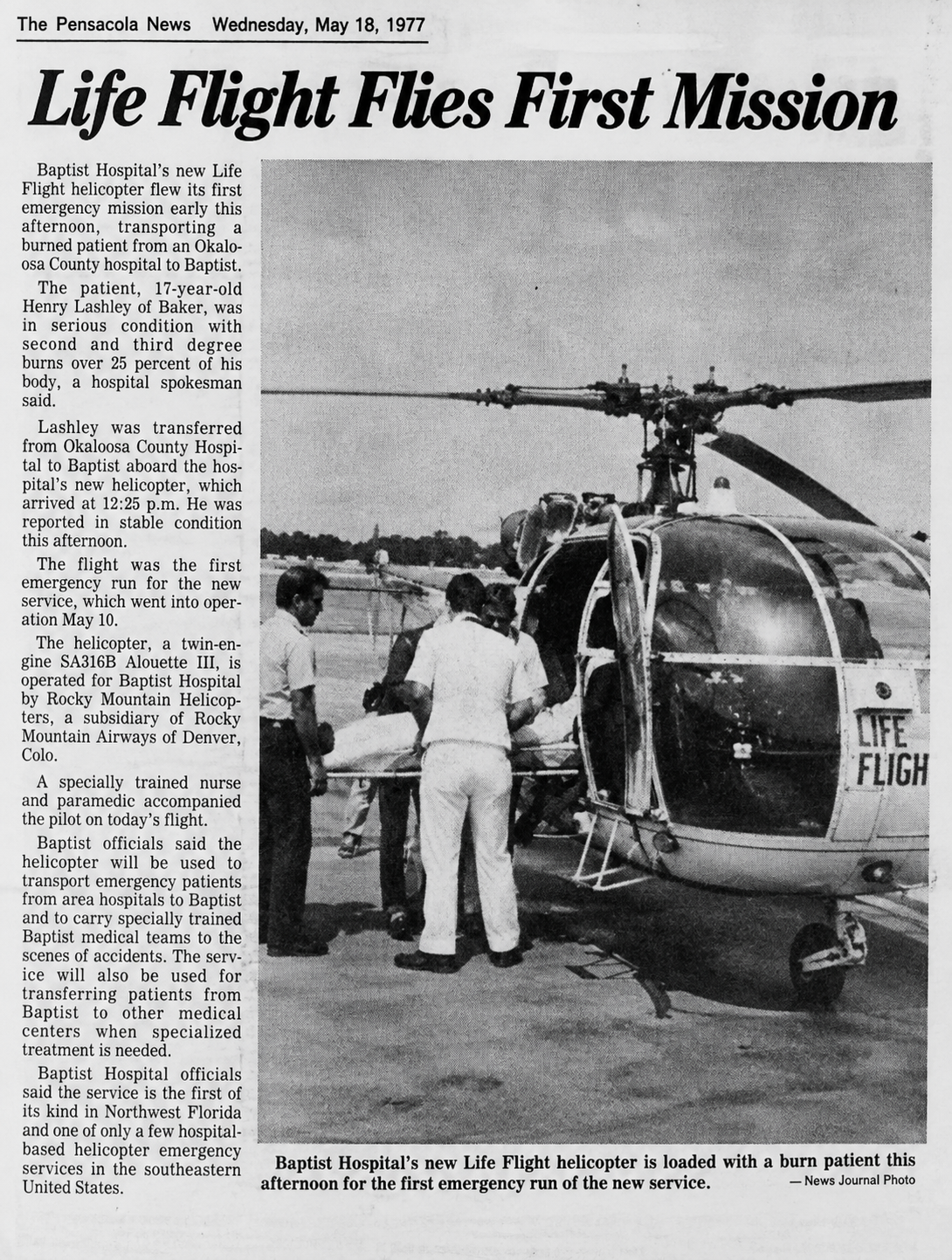
On May 10, 1977, Baptist Hospital inaugurated its new Life Flight helicopter service using an SA316B Alouette III operated by Rocky Mountain Helicopters.
The program’s first emergency mission occurred on May 18, 1977, when N8394 transported burn patient Henry Lashley to Baptist Hospital. Contemporary newspaper coverage documented the mission under the headline “Life Flight Flies First Mission.”
FROM THE ARCHIVES
“Life Flight Flies First Mission” — May 18, 1977
A contemporary Pensacola newspaper documented Baptist Life Flight’s first emergency mission, eight days after the service was inaugurated.
Source: The Pensacola News, May 18, 1977.
1978 — Emanual Life Flight
Emanuel Hospital — Portland, Oregon
Emanuel Hospital began operating its Life Flight helicopter service on February 28, 1978, using an SA316B Alouette III, N5954, operated by Rocky Mountain Helicopters.
The program transported its first patient on March 1, 1978. Early personnel included pilots Bill Singer and Bill Browder, flight nurse Ben Pessin, and Floyd Helm, who was involved with Aviation Medical Services and the development of the program.
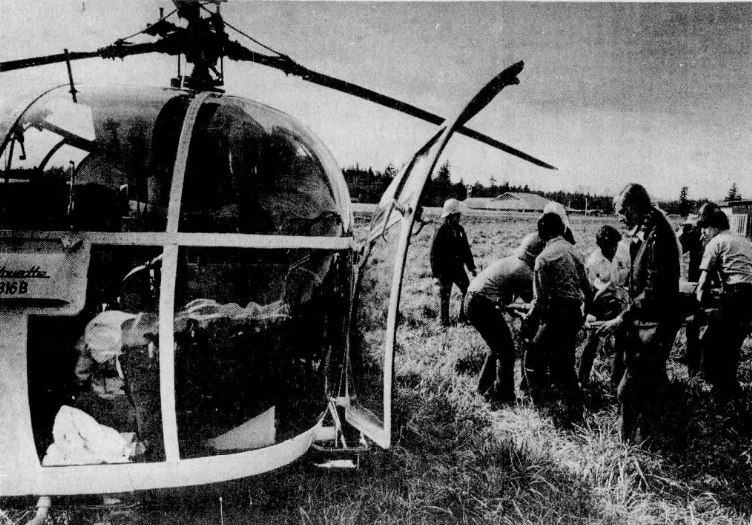
Emanuel Life Flight — 1978
Training drill before the program’s launch.
The Oregonian, February 23, 1978, p. 32
1978 — Spirit of St. Joseph Life Flight
St. Joseph Hospital — Kansas City, Missouri
Spirit of St. Joseph Life Flight began operations on June 1, 1978, using an Alouette III. Contemporary reporting immediately before the program’s launch documents N8259 with the service.
The helicopter’s first reported patient mission occurred during a demonstration in Clinton, Missouri. While the aircraft was there, a motorcycle accident occurred and the demonstration helicopter was called into service to transport the injured rider to the hospital.
A second early mission occurred in Cass County, Missouri, when the helicopter transported a woman injured in a two-vehicle accident to the emergency department at St. Joseph Hospital. A June 15 contemporary newspaper account specifically described this as the second time the helicopter had been used, identifying the Clinton demonstration mission as the first.
Historical context: Contemporary reporting described Spirit of St. Joseph as a regional air medical service supporting seven member communities, providing helicopter transportation for emergency and critical-care patients.
Aircraft note: Contemporary photographic evidence from May 31, 1978 documents N8259 with Spirit of St. Joseph immediately before the program entered service. Current evidence establishes N8259 as a launch-era aircraft, although RotorPedia has not yet confirmed that N8259 itself flew the first patient mission at Clinton.
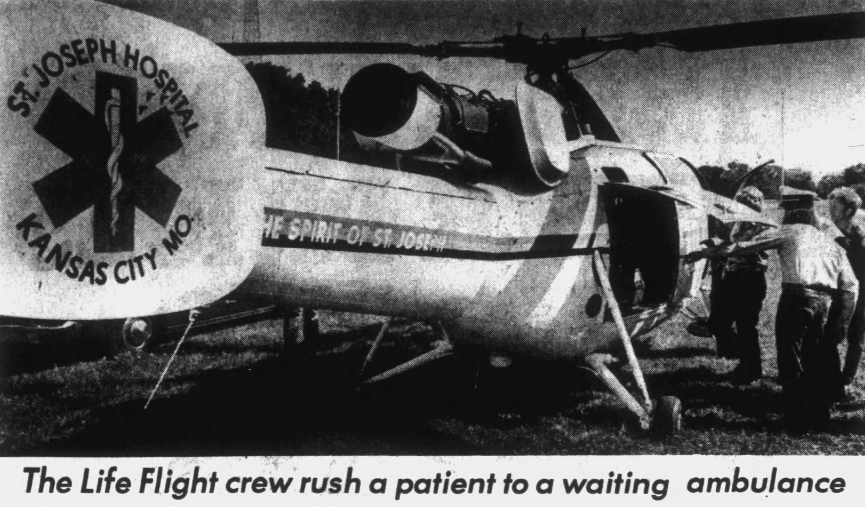
Spirit of St. Joseph Life Flight — 1978
Life Flight crew during a patient transfer.
The Kansas City Times, June 29, 1978, p. 40
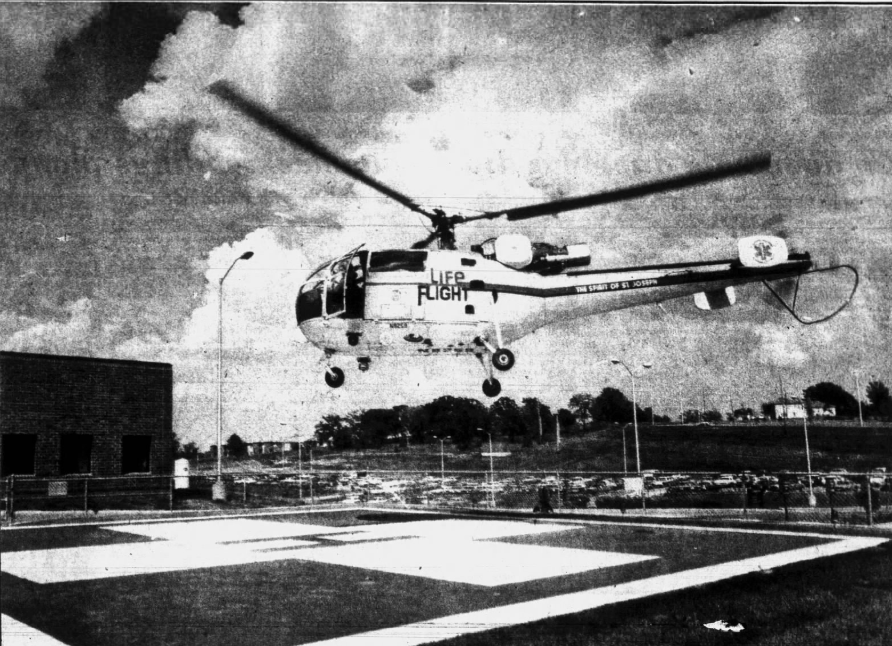
Spirit of St. Joseph Life Flight — 1979
Life Flight landing at its St. Joseph Hospital base in Kansas City.
St. Joseph News-Press, June 10, 1979, p. 27
1978 — University of Utah / Salt Lake City Cooperative Helicopter Service
University Medical Center — Salt Lake City, Utah
On June 15, 1978, University Medical Center and three other Salt Lake City hospitals inaugurated a cooperative helicopter patient-transport service in partnership with Key Airlines. Participating hospitals included University Medical Center, St. Mark’s Hospital, Holy Cross Hospital, and Primary Children’s Medical Center.
The service used a Bell LongRanger based at Key Airlines at Salt Lake City International Airport. University of Utah Hospital leased the helicopter from Key Airlines, which supplied the aircraft and aviation operation. The helicopter primarily transported critically ill or injured patients from hospitals within approximately a 100-mile radius of Salt Lake City.
Medical crews consisted of either two nurses or a physician and nurse, depending on the patient’s needs. Early reporting emphasized transports involving critically injured patients, newborn infants, high-risk maternal patients, and patients requiring specialized medical or surgical care.
Early missions are documented. By July, the service was using landing sites at outlying hospitals, including St. Benedict’s Hospital, where contemporary reporting documented infant transports to University Medical Center and Primary Children’s Medical Center.
Aircraft: A Bell LongRanger, N2DC, is photographically documented in service by July 1978. A contemporary photograph shows N2DC at St. Benedict’s Hospital while a transport team loads a one-month-old infant for a flight to Primary Children’s Medical Center.
Research note: Contemporary evidence establishes June 15, 1978 as the inauguration date. Although early patient missions and N2DC are now documented, RotorPedia has not yet identified the first patient mission or confirmed that N2DC was the helicopter used when the service inaugurated operations.
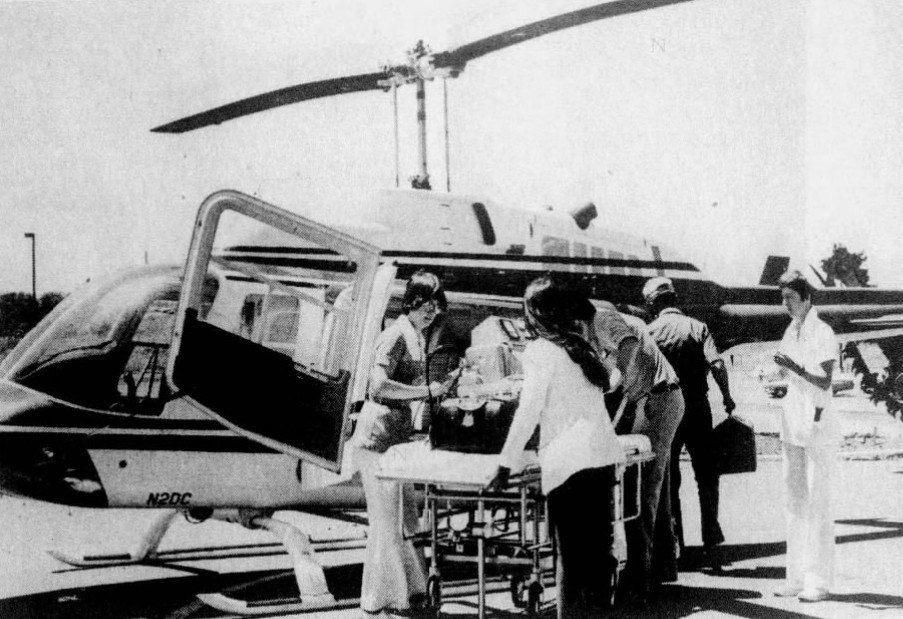
Salt Lake City Cooperative Helicopter Service — 1978
Transport personnel load a one-month-old infant at St. Benedict’s Hospital for a flight to Primary Children’s Medical Center aboard Bell LongRanger N2DC.
The Morgan County News, July 14, 1978, p. 4
1978 — LDS Hospital Life Flight
LDS Hospital — Salt Lake City, Utah
LDS Hospital announced in June 1978 that it would establish a 24-hour helicopter emergency medical transport service serving portions of Utah, Nevada, Idaho, and Wyoming. The program was scheduled to begin regular operations in mid-July 1978.
The helicopter began carrying patients before its planned formal start. On July 6, contemporary reporting documented an early patient transport from Roosevelt, Utah. Days later, the aircraft responded to American Fork Hospital for a child critically injured in an automobile accident, despite regular service not being scheduled to begin until July 17–18.
On the American Fork mission, the helicopter was airborne within approximately five minutes of receiving the call and reached the hospital about 13 minutes later. A physician and registered nurse accompanied the child during the flight to Primary Children’s Medical Center.
Historical context: LDS Hospital developed its helicopter program separately from the four-hospital cooperative service operated with Key Airlines, which had begun on June 15. LDS had been invited to participate in that system but elected to establish its own service. Contemporary reporting indicated that the two systems could provide backup for one another.
Research note: Contemporary sources establish patient operations by July 6, 1978, preceding the program’s originally scheduled mid-July start. RotorPedia therefore distinguishes between the first documented patient operations and the planned formal beginning of regular service.
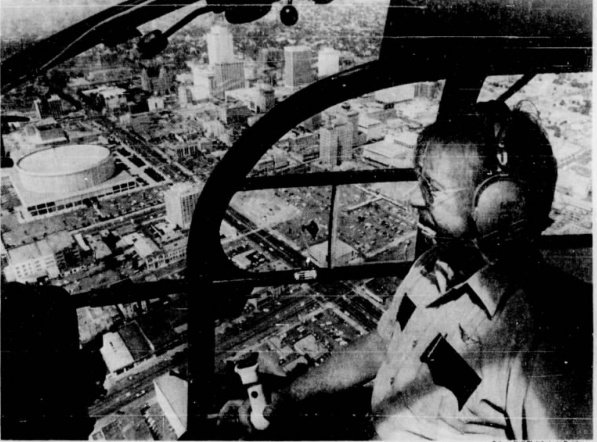
LDS Hospital Life Flight — 1978
Life Flight helicopter during the program’s early operations.
The Salt Lake Tribune, July 6, 1978, p. 21
1978 — Allegheny General Life Flight
Allegheny General Hospital — Pittsburgh, Pennsylvania
Allegheny General Hospital, working with the Emergency Medical Services Institute of Southwestern Pennsylvania, established its Life Flight Emergency Helicopter Service in September 1978. Following several weeks of training and familiarization flights, the program was scheduled to begin official operations on September 22, 1978.
Life Flight was designed as a 24-hour, seven-day-a-week regional medical transport service, serving an approximately 130-mile radius of Pittsburgh that extended into western Pennsylvania and portions of West Virginia, Maryland, and Ohio.
The program operated an SA316B Alouette III provided under contract by Aviation Medical Services of Houston. Flight nurses received specialized training in coronary, respiratory, neonatal, trauma, and other critical-care emergencies, while physicians participated when needed. Medical direction during flights and at emergency scenes was provided by Allegheny General physicians.
Contemporary reporting described Allegheny General’s Life Flight as the “first hospital-based service of its kind in the Northeastern United States.” RotorPedia preserves this as a contemporary historical claim rather than a verified national or regional ranking.
Aircraft: SA316B Alouette III N72590 is confirmed as an early Allegheny General Life Flight aircraft.
Research note: Contemporary sources establish September 22, 1978 as the planned beginning of official operations. RotorPedia has not yet identified the program’s first patient mission.
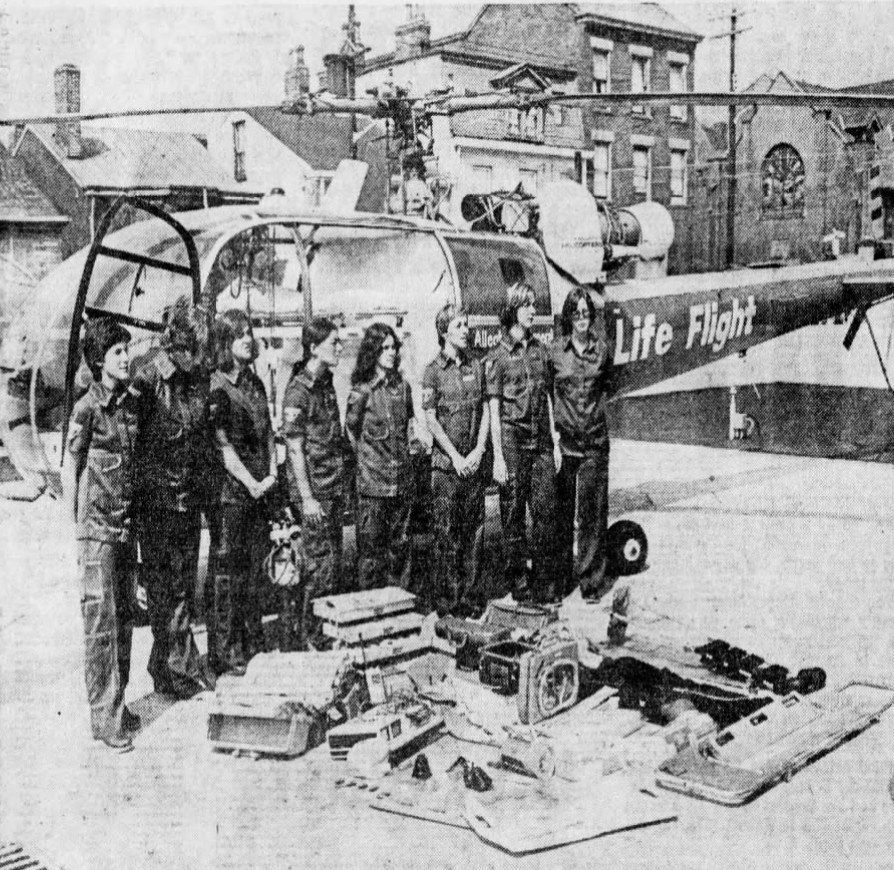
Allegheny General Life Flight — 1978
Flight nurses and medical equipment with the Life Flight Alouette III shortly before official operations began.
The Pittsburgh Press, September 8, 1978, p. 2
1978 — Life Flight Southern California
Daniel Freeman Hospital / Long Beach Memorial Medical Center — California
On October 1, 1978, Daniel Freeman Hospital in Inglewood and Long Beach Memorial Medical Center joined together to establish Life Flight Southern California, a helicopter emergency medical service serving Southern California.
The service operated an SA316B Alouette III supplied and operated by Aviation Medical Services. The helicopter was configured as an airborne ambulance capable of carrying two stretcher patients and two flight nurses in addition to the pilot.
The aircraft alternated its base weekly between the rooftop helipad at Long Beach Memorial and a designated landing area at Daniel Freeman Hospital. Operating around the clock, Life Flight could be requested by hospitals, physicians, fire and law-enforcement agencies, paramedics, ambulance services, and industrial safety personnel.
Flight nurses maintained radio communications with physicians at Daniel Freeman and Long Beach Memorial while patients were being transported. The helicopter cruised at approximately 115 mph and could reportedly be airborne within about three minutes after a request was received at the Daniel Freeman communications center.
Early personnel identified in contemporary reporting included flight nurses Sharon Englert, Sue Cunnane, and Roy Evans, with Theodore R. Cash and Robert Locke among the pilots.
Aircraft: SA316B Alouette III N2354 is photographically confirmed with the Aviation Medical Services Life Flight operation in September 1978, during preparations for the Southern California service.
Research note: Contemporary reporting establishes October 1, 1978 as the operational beginning of Life Flight Southern California. An October 22 Los Angeles Times report stated that the flying ambulance had become operational “at the first of this month.”
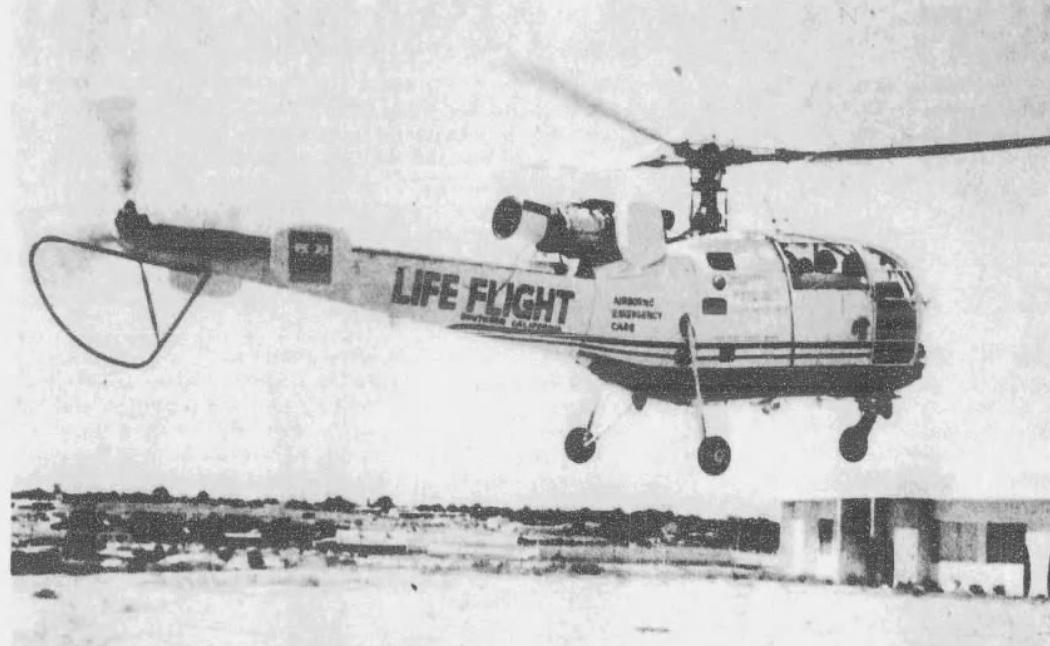
Life Flight Southern California — 1978
Alouette III N2354 operated by Aviation Medical Services during preparations for the Southern California Life Flight program.
Simi Valley Star, September 25, 1978, p. 16
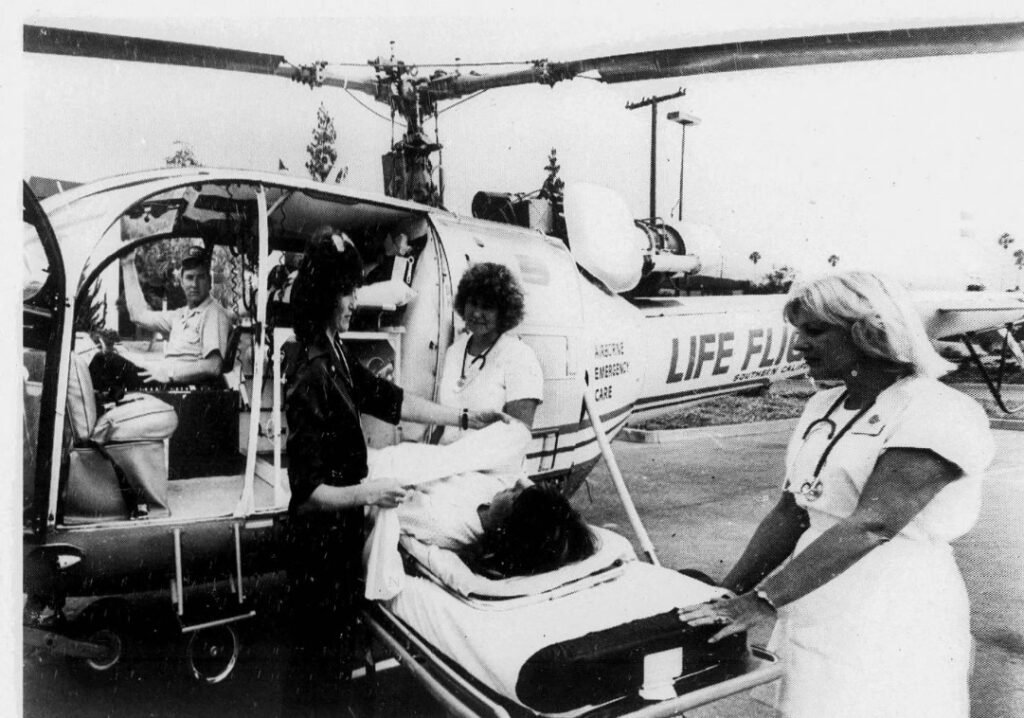
Life Flight Southern California — 1978
Alouette III N2354 operated by Aviation Medical Services during preparations for the Southern California Life Flight program.
The Los Angeles Times, October 22, 1978, p. 575
1978 — Medi-Flight: Memorial Hospital
Memorial Hospital — Modesto, California
Memorial Hospital’s Medi-Flight helicopter service began operations on December 1, 1978, using an SA316B Alouette III, N6456. Aviation services were provided by Continental Helicopters of Utah.
The program’s first patient mission occurred at approximately 5:00 a.m. on December 2, 1978, when 42-year-old Calvin Michener was transported from Westside Community Hospital in Newman to Memorial Hospital in Modesto.
The early crew included pilot Pat Parkhill, paramedic Rick Donker, and nurse Kathie Wallace.
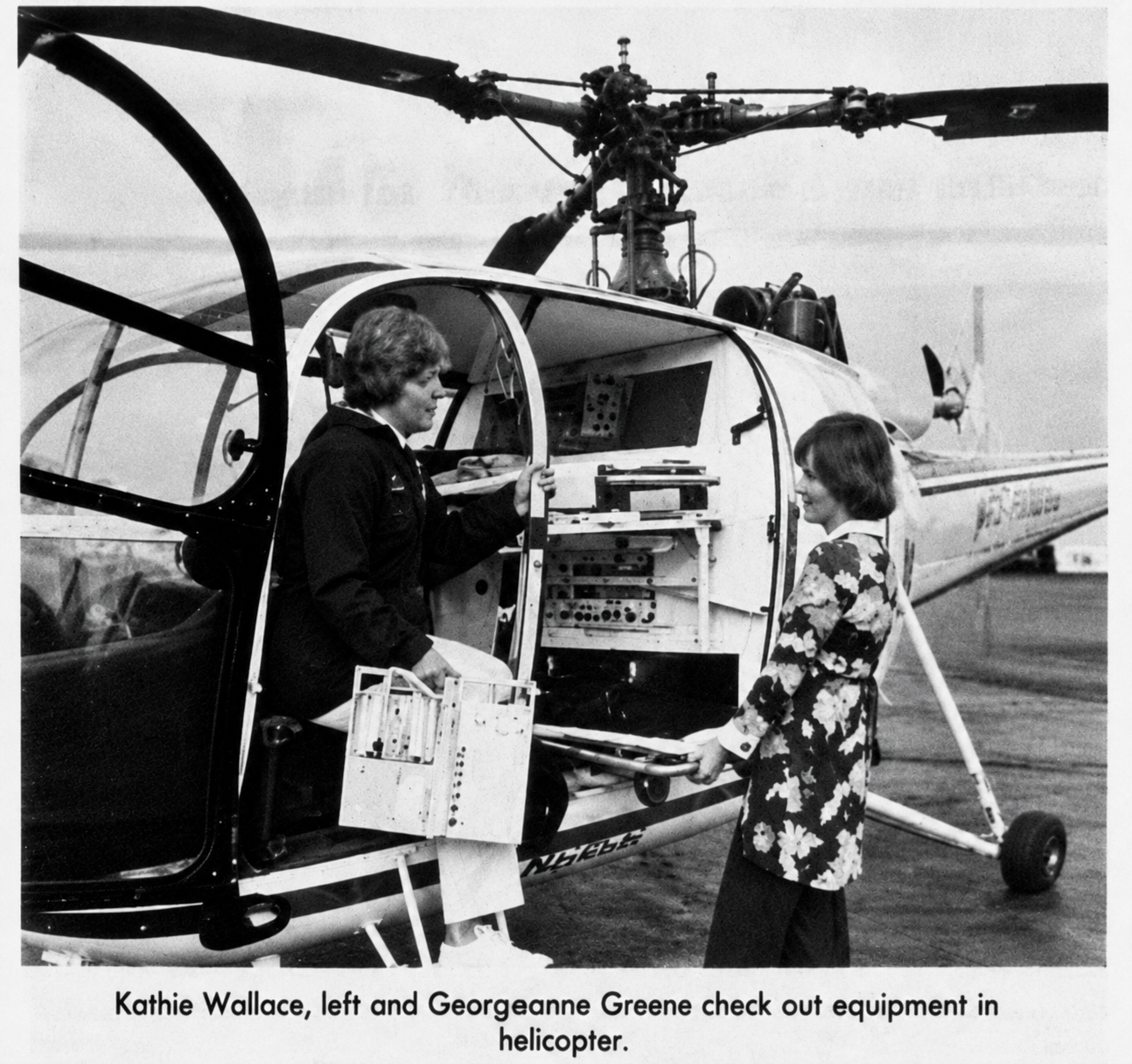
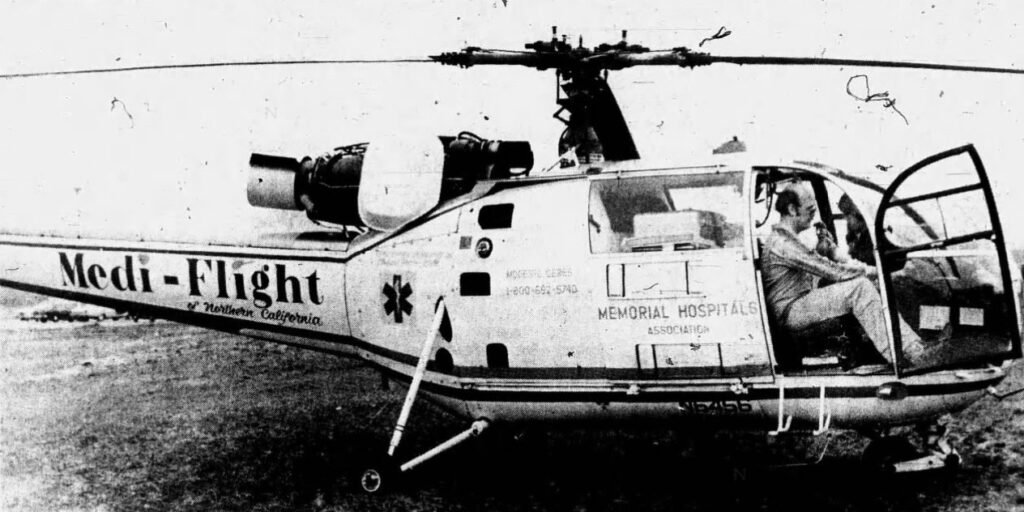
FROM THE ARCHIVES
“Air Ambulance” — November 14, 1978
Contemporary coverage in The Modesto Bee introduced Memorial Hospital’s new Medi-Flight service shortly before operations began. The article included a photograph of the Alouette III and its specialized medical equipment.
Source: The Modesto Bee, November 14, 1978.
EARLY MISSION
“Mercy Flight To Save Man’s Thumb” — January 5, 1979
Only weeks after Medi-Flight began operations, the helicopter was called to Emanuel Hospital in Turlock for 26-year-old Jesus Aguilar, whose thumb had been nearly severed in a pruning accident. Medi-Flight transferred Aguilar to Ralph K. Davies Hospital in San Francisco for specialized treatment.
The crew responded in approximately 10 minutes, landing on Emanuel Hospital’s north lawn. Pilot Pat Parkhill and flight nurse Connie Hurd participated in the mission, with Hurd providing patient care during the flight.
Source: Turlock Journal, January 5, 1979, p. 1.
1979 — Medical Air Rescue Corps (MARC)
St. Louis University Medical Center — St. Louis, Missouri
The Medical Air Rescue Corps (MARC) began operations in the St. Louis region in March 1979, with St. Louis University Medical Center serving as the coordinating medical center. The service was designed to provide rapid helicopter transport for critically ill and injured patients throughout a broad region surrounding St. Louis, generally within approximately a 100-mile radius. Contemporary descriptions show that MARC was intended for both emergency rescue missions and hospital-to-hospital transfers, with additional roles envisioned for disaster response and specialized medical transportation.
MARC used a Sikorsky S-55 supplied and operated by St. Louis Helicopter Airways, Inc. The large helicopter could accommodate as many as three stretcher patients and two medical attendants and carried equipment for critical-care transport. A typical medical crew consisted of a registered nurse trained in emergency and critical-care nursing, with additional medical personnel available when required. The helicopter was based at the new heliport serving St. Louis University Hospitals on South Grand Boulevard.
Contemporary reporting immediately before the launch documented introductory visits to hospitals throughout the region as MARC prepared to begin service. A February 27, 1979 Greenville Advocate article described an introductory hospital visit under the headline “Service Begins Thursday,” providing additional contemporary support for a March 1, 1979 operational start. Subsequent newspaper coverage documented the helicopter operating throughout the region during the spring of 1979.
Aircraft: Sikorsky S-55, N6704 — confirmed.
Aviation operator: St. Louis Helicopter Airways, Inc. — confirmed.
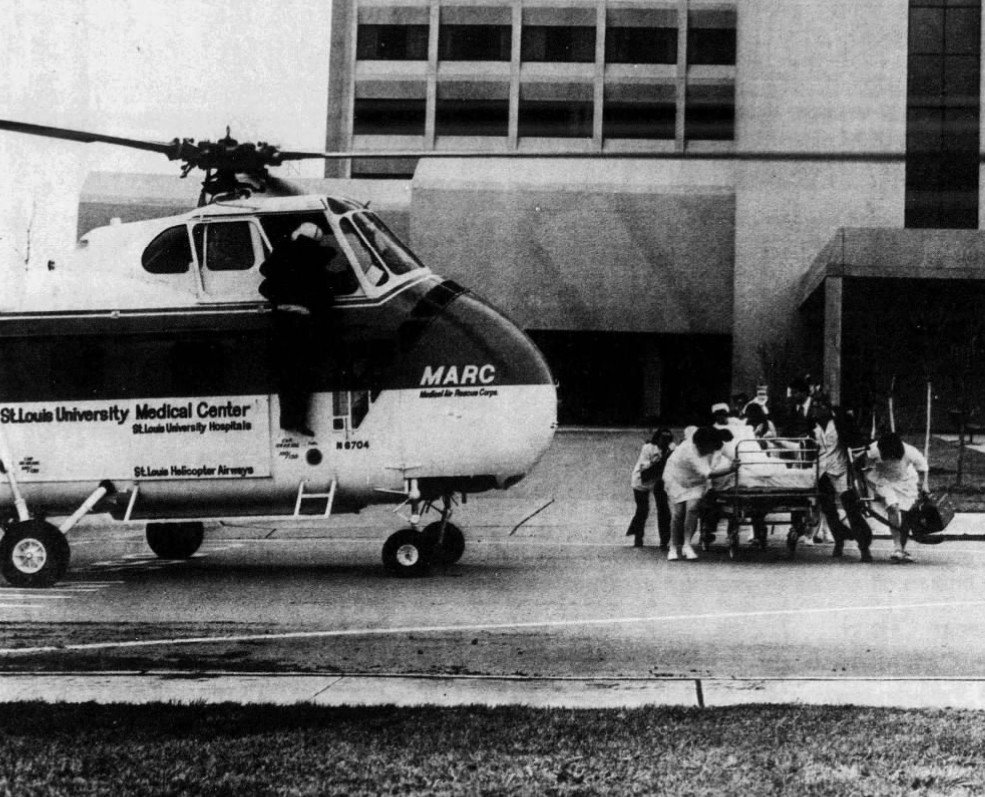
FROM THE ARCHIVES
“First Patient in Helicopter Ambulance Moved From Here to St. John’s” — March 3, 1979
Contemporary coverage in the Washington Citizen documented MARC’s first patient transport, a woman in premature labor flown from St. Francis Mercy Hospital in Washington, Missouri, to St. John’s Mercy Medical Center in St. Louis. The accompanying photograph shows Sikorsky S-55 N6704 and the patient transfer.
Source: Washington Citizen, March 3, 1979, p. 1.
1979 — St. Vincent HELP Flight
St. Vincent Hospital — Billings, Montana
St. Vincent HELP Flight began operations in mid-March 1979, providing helicopter medical transport across a broad region of eastern Montana and northern Wyoming.
The program grew from helicopter medical activity already underway in Billings. By late 1978, local operator Gerhart Blain had a medically equipped Bell JetRanger in service while St. Vincent was developing its hospital heliport and regional trauma capabilities. The HELP Flight helicopter could carry critically ill or injured patients from communities within approximately a 200-mile radius of Billings.
HELP Flight quickly developed into an active regional service. Contemporary photographs from April 1979 show a Bell JetRanger carrying HELP markings at St. Vincent Hospital. The registration of this early aircraft remains unresolved.
Historical note: On August 30, 1980, the HELP Flight JetRanger crashed during a mountain rescue at Glacier Lake, killing flight nurse Alean Hartford and two patients; pilot Lynn Webb survived. Helicopter operations were temporarily suspended. On December 8, 1980, HELP Flight resumed with a Bell LongRanger II operated by Rocky Mountain Helicopter and based directly at St. Vincent Hospital.
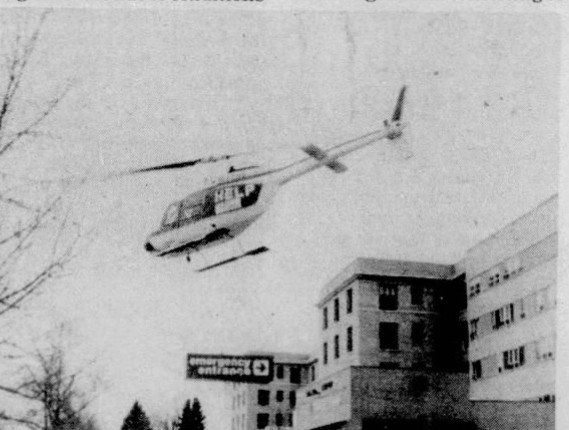
St. Vincent HELP Flight — 1979
Bell JetRanger carrying HELP Flight markings during the program’s first months of operation at St. Vincent Hospital.
Laurel Outlook, April 11, 1979, p. 18
1979 — Air Evac
Good Samaritan Hospital / John C. Lincoln Hospital — Phoenix, Arizona
Phoenix’s Air Evac helicopter service flew its first emergency patient on March 1, 1979, several days before the new service was scheduled to begin regular operations.
The first patient was newborn Jason Scott Kirk, who was born in critical condition at Kennecott Copper Corp. Hospital. A fixed-wing transfer was initially requested, but flooding had closed nearby Kearny Airport, prompting Air Evac to use its Alouette 316-B to transport the infant to St. Joseph’s Hospital in Phoenix.
The joint 24-hour helicopter service, operated in association with Samaritan Health Service and John C. Lincoln Hospital, formally began on March 10, 1979. The helicopter could be airborne within approximately three to five minutes of an emergency call and was staffed by specially trained flight nurses.
Aircraft: Contemporary reporting confirms an Alouette 316-B was used for Air Evac’s first patient mission. The aircraft registration remains unresolved.
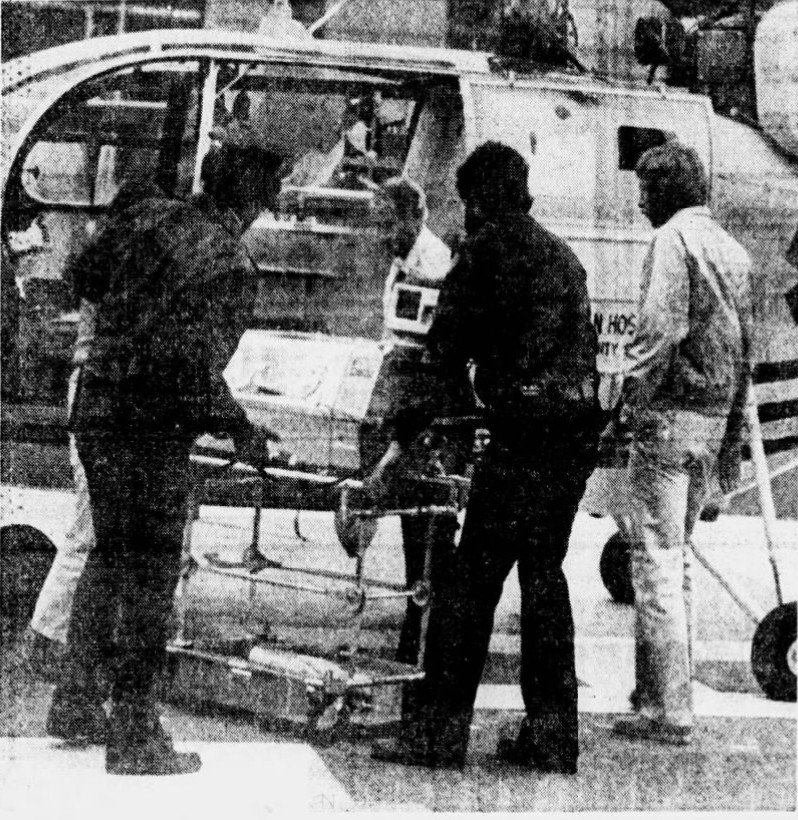
Air Evac — First Mission, 1979
Air Evac personnel load neonatal equipment for the March 1 transport of newborn Jason Scott Kirk to St. Joseph’s Hospital in Phoenix.
Arizona Republic, March 3, 1979, p. B-6
1979 — Survival Flight
Phoenix Baptist Hospital — Phoenix, Arizona
Survival Flight began helicopter medical operations at Phoenix Baptist Hospital on March 9, 1979, becoming one of two new hospital-based helicopter services to begin operating in Phoenix within days of one another.
Phoenix Baptist had announced the program earlier that year, initially planning an April launch. Airwest Helicopters of Fort Collins, Colorado, was contracted to provide the helicopter, pilots, and mechanics. The service ultimately began ahead of schedule on March 9.
Operating 24 hours a day, seven days a week, Survival Flight provided both emergency patient retrieval and interhospital transportation. The helicopter could carry two patients and two medical personnel in addition to the pilot, and patients could be transported to the hospital most appropriate for their medical needs rather than automatically being taken to Phoenix Baptist.
Aircraft: Contemporary planning documents describe the inaugural aircraft as an Alouette III helicopter, but its registration remains unresolved. N4875 is photographically confirmed with Survival Flight by 1981, but RotorPedia has not established that it was the aircraft used when the program began in 1979.
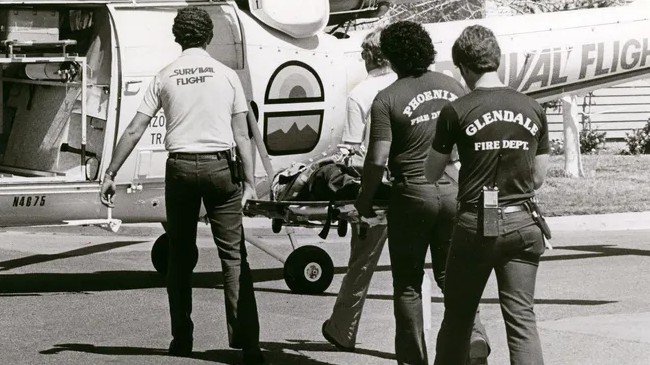
Survival Flight — 1981
Survival Flight helicopter N4875 receives a patient during an emergency transport in 1981.
Arizona Republic Archive
1979 — University of Iowa AirCare
University of Iowa Hospitals — Iowa City, Iowa
Air-Care emerged in early 1979 as the University of Iowa’s new helicopter medical transport service. The program’s helicopter arrived in Iowa City on February 23, 1979, followed by several weeks of preparation, training, and visits to hospitals across Iowa to identify landing sites and introduce the new service.
Patient operations were underway by March 28, 1979, when Air-Care transported Jason Erwin, a young Muscatine resident who had suffered a head injury in a fall. Contemporary reporting later identified April 1, 1979, as the date the helicopter formally went into service.
Designed to extend the resources of University Hospitals to communities throughout Iowa, Air-Care provided rapid emergency and interhospital transportation. A critical-care nurse accompanied the helicopter, with a physician available when indicated or requested. Early reports described a service area extending up to approximately 200 miles round trip.
Aircraft: Air-Care began operations with an Aérospatiale AS350D AStar, N352RM.
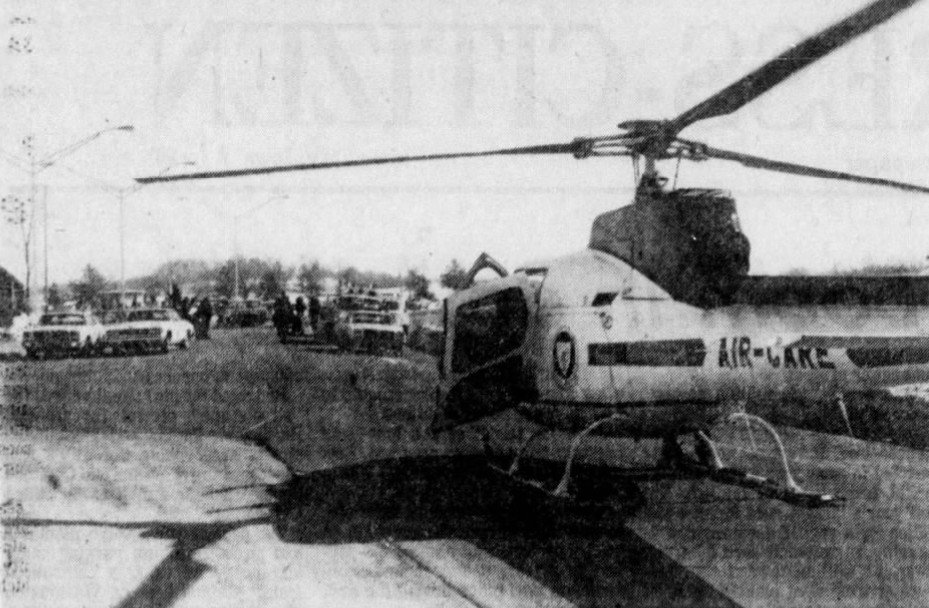
University of Iowa Air-Care — 1979
The new Air-Care helicopter at University of Iowa Hospitals during preparations for the program’s launch in early 1979.
Iowa City Press-Citizen, February 26, 1979
1979 — Cedar Rapids Air Ambulance
City of Cedar Rapids / Area Ambulance Service — Cedar Rapids, Iowa
Cedar Rapids Air Ambulance officially began operations on February 22, 1979, providing 24-hour helicopter emergency medical transport across a 13-county region of eastern Iowa.
Unlike many of the hospital-sponsored programs emerging during this period, the Cedar Rapids service was an extension of the city-owned Area Ambulance Service. Its jet-powered UH-1 Huey was based at the Cedar Rapids airport. When dispatched, the helicopter could fly to Area Ambulance headquarters at Mercy Hospital to pick up emergency medical personnel before proceeding to the patient.
The helicopter was equipped with cardiac telemetry, hospital communications, and emergency medical equipment comparable to a ground ambulance, and could carry two patients. Both Mercy Hospital and St. Luke’s Hospital maintained helicopter landing areas and participated in the developing regional system.
On launch day, a trial mission carried Area Ambulance Director Tim Trosky and EMT Jim Myers from Mercy Hospital to Center Point, where a simulated critically injured patient was picked up and flown to St. Luke’s Hospital. The return flight took approximately eight minutes.
Aircraft: The original Cedar Rapids Air Ambulance operated a jet-powered UH-1 Huey, N45855, obtained as military surplus.
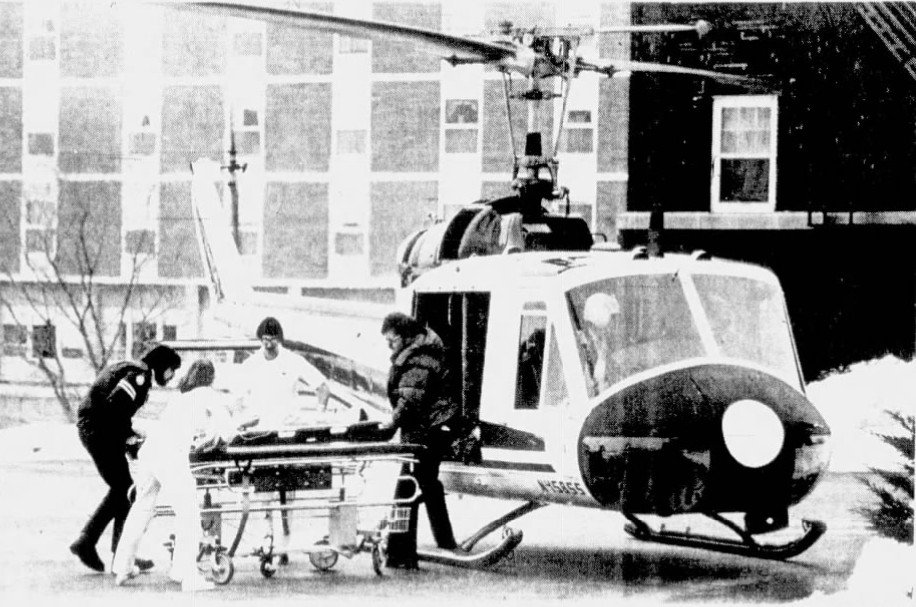
Cedar Rapids Air Ambulance — February 22, 1979
Area Ambulance personnel and St. Luke’s Hospital Trauma Center staff unload a simulated patient during a launch-day trial mission at St. Luke’s Hospital.
The Gazette, February 22, 1979, p. 6A
1979 — Air Care
West Jefferson General Hospital — Marrero, Louisiana
Air Care began helicopter medical operations at West Jefferson General Hospital in April 1979, providing rapid emergency and interhospital transportation for patients in the New Orleans region and surrounding communities.
The program used a Bell 206L-1 LongRanger operated by Air Logistics, with West Jefferson providing the medical component of the service. Contemporary photographs show the helicopter prominently marked AIR CARE and WEST JEFFERSON GENERAL HOSPITAL.
The program quickly became active. By August 1979, contemporary reporting stated that Air Care had already transported 58 patients since April, demonstrating the growing role of helicopter transport in extending hospital-based emergency and specialty care beyond the immediate New Orleans area.
Aircraft: Air Care operated a Bell 206L-1 LongRanger during its first year of service. N5012Z is the leading candidate for the launch-era aircraft, but RotorPedia has not yet independently confirmed the registration.
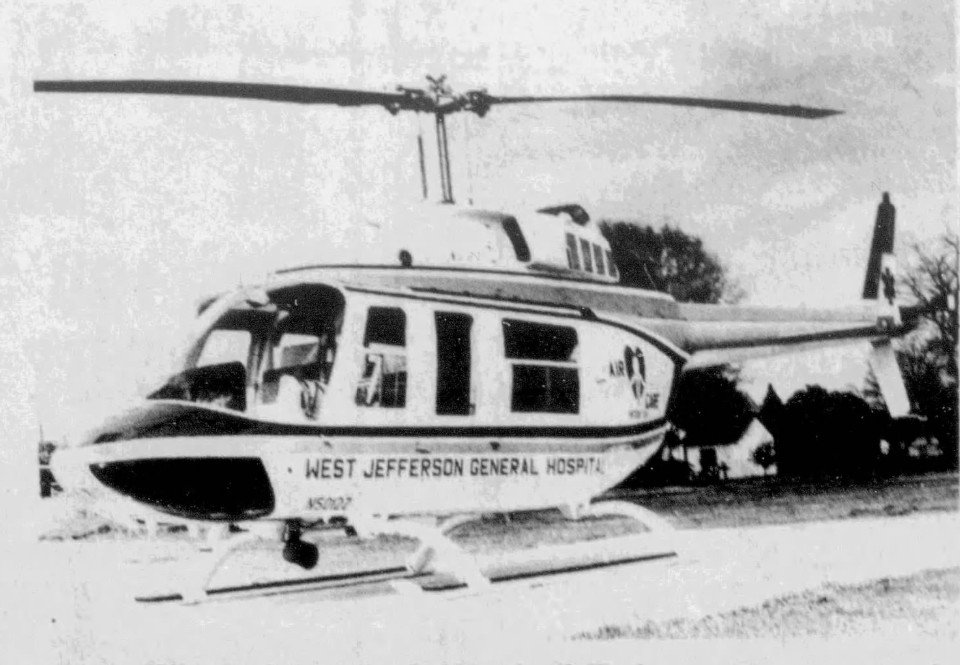
West Jefferson Air Care — 1979
West Jefferson General Hospital’s Air Care Bell 206L-1 LongRanger during the program’s first year of operation.
The Courier, August 9, 1979, p. 35
1979 — St. Joseph Life Flight
St. Joseph Hospital / Creighton University — Omaha, Nebraska
Life Flight began a 90-day trial period in June 1979, extending St. Joseph Hospital’s emergency and specialty-care capabilities to communities across Nebraska, Iowa, Missouri, and South Dakota. Before patient operations began, the new helicopter visited regional hospitals and communities to introduce the service and familiarize local medical personnel with its capabilities.
The program’s first patient mission occurred June 22, 1979, when Life Flight flew to Rosary Hospital in Corning, Iowa, to transport 2½-month-old Thomas Wayne Andrews of Prescott, Iowa, to St. Joseph Hospital in Omaha. The infant was seriously ill with convulsions and a high fever and was later diagnosed with hemolytic-uremic syndrome.
Life Flight quickly exceeded expectations. During its first 35 days, the helicopter transported 27 patients on 24 missions, including three flights carrying two patients. Early reporting described a service area extending approximately 150 miles from Omaha, with a registered nurse aboard each flight and additional medical personnel assigned according to the patient’s condition.
Aircraft: The original Life Flight service used an Aérospatiale AS350 AStar supplied by Aviation Medical Services. N354RM is the leading candidate for the launch-era aircraft, but RotorPedia has not yet independently confirmed the registration.
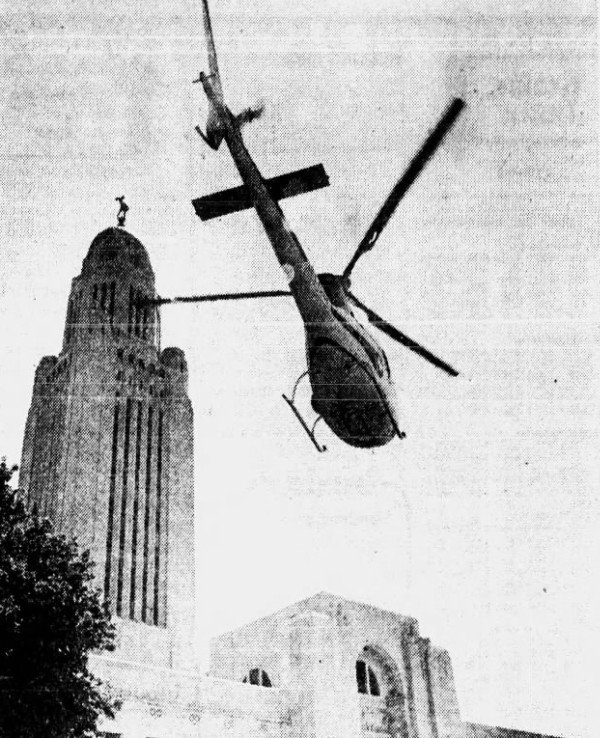
St. Joseph Life Flight — 1979
St. Joseph Hospital’s new Life Flight helicopter passes the Nebraska State Capitol during a pre-launch visit to Lincoln in June 1979.
Lincoln Journal Star, June 12, 1979, p. 11
1979 — Iowa Methodist Life Flight
Iowa Methodist Medical Center — Des Moines, Iowa
Life Flight began helicopter medical operations at Iowa Methodist Medical Center on July 12, 1979, providing rapid emergency and interhospital transportation across central Iowa and surrounding communities.
The program used an Aérospatiale AS350 AStar operated by Rocky Mountain Helicopters of Provo, Utah. Early reporting described a service area extending approximately 150 miles from Des Moines, with the helicopter capable of carrying two patients and providing advanced medical care during transport.
Life Flight carried its first patient on July 17, 1979, just five days after the service began. Craig Jensen, 18, of Alta, Iowa, was seriously injured when his car collided with a train near Fort Dodge. He was transported from Trinity Regional Hospital in Fort Dodge to Iowa Methodist Medical Center in approximately 20 minutes.
Aircraft: Life Flight began operations with an Aérospatiale AS350 AStar. N353RM is the leading candidate for the launch-era aircraft, but RotorPedia has not yet independently confirmed the registration.
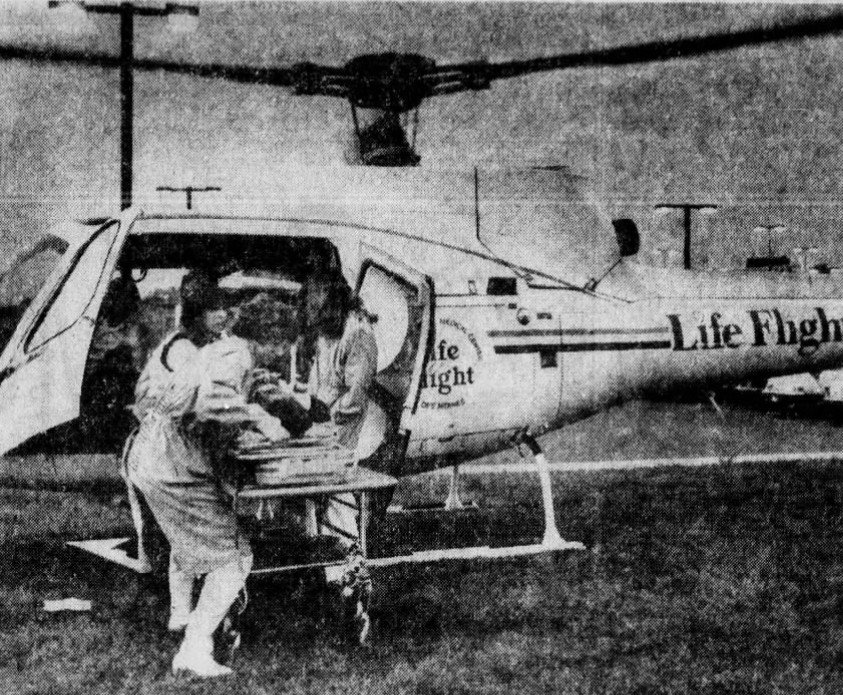
Iowa Methodist Life Flight — 1979
Iowa Methodist Medical Center’s Life Flight helicopter during a patient transport in the program’s first year of operation.
Des Moines Register, October 12, 1979, p. 41
1979 — Methodist Hospital Life Line
Methodist Hospital — Indianapolis, Indiana
Life Line began helicopter medical operations at Methodist Hospital in Indianapolis in July 1979, providing rapid emergency transport for critically injured and seriously ill patients throughout central Indiana.
The program operated a Bell 206L-1 LongRanger equipped for medical transport. The helicopter allowed Methodist Hospital’s emergency-care capabilities to reach accident scenes and communities well beyond Indianapolis, significantly reducing transport times for patients requiring specialized treatment.
A documented early mission occurred on July 16, 1979, when Ronald Bratcher of Indianapolis was seriously injured in a motor-vehicle crash on Indiana 37 north of Martinsville, near Waverly. Bratcher was transported by helicopter to Methodist Hospital, where he was listed in serious condition the following day.
Aircraft: Life Line operated a Bell 206L-1 LongRanger, N27554. The registration is photographically confirmed on a Life Line aircraft in an August 1979 Indianapolis Star photograph.
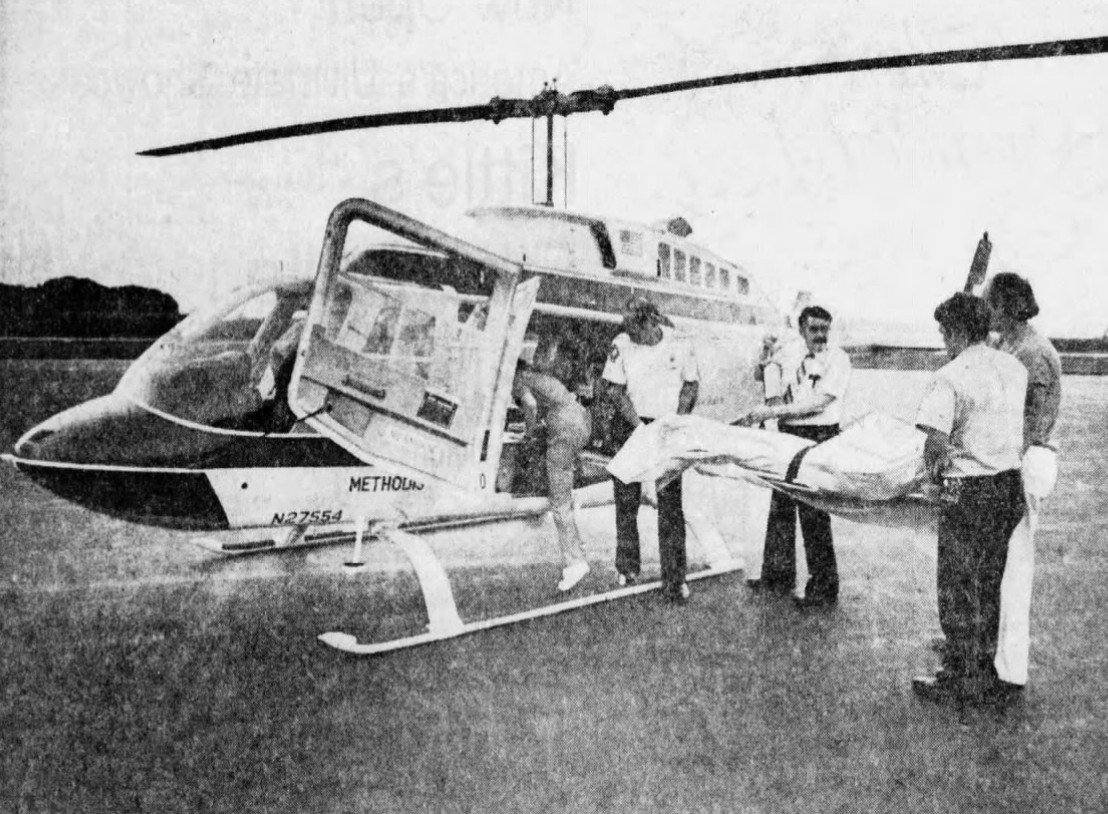
Methodist Hospital Life Line — 1979
Methodist Hospital’s Life Line Bell 206L-1 LongRanger, N27554, during the program’s first months of operation.
Indianapolis Star, August 12, 1979, p. 126
1979 — St. Vincent Life Flight
St. Vincent Hospital and Medical Center — Toledo, Ohio
Life Flight began helicopter operations at St. Vincent Hospital on July 31, 1979, starting with a two-week training and orientation period during which the helicopter was also available for emergency patient missions. The program was scheduled to enter full operation as a one-year trial on August 15.
Life Flight made its first emergency run on August 1, 1979, transporting John Gilmore, 19, of Sandusky, who had been critically injured in a motorcycle accident on U.S. 6 near Sandusky. Gilmore was flown from Memorial Hospital in Sandusky to Medical College Hospital in Toledo.
The helicopter was staffed by a pilot, physician, and registered nurse and was equipped to carry two patients. St. Vincent described the aircraft as essentially a “flying emergency room,” with the service designed to cover communities within approximately a 130-mile radius of Toledo.
Aircraft: Life Flight operated an Aérospatiale Alouette III during its launch period. N83716 is identified in RotorPedia’s research as the launch-era aircraft, although the registration is not readable in the contemporary photograph used here.
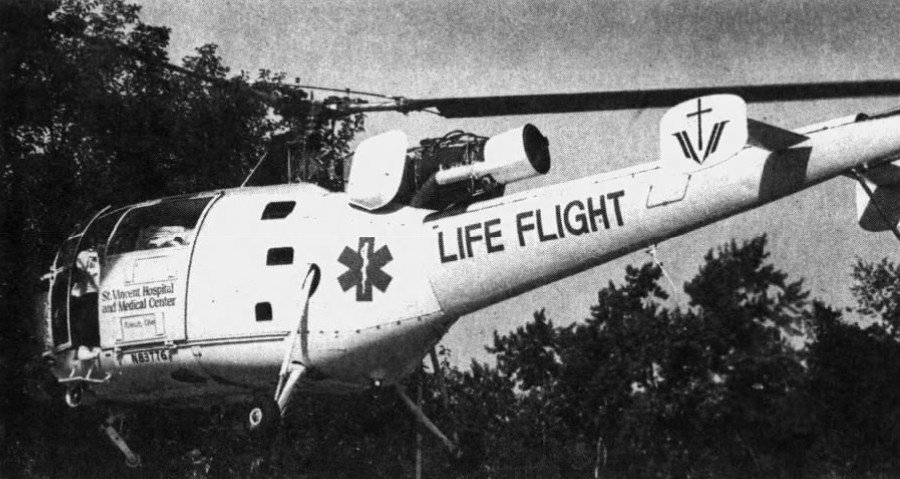
St. Vincent Life Flight — 1979
St. Vincent Hospital’s Life Flight Alouette III during the program’s initial weeks of service in August 1979.
The News-Messenger, August 13, 1979, p. 4
1979 — Tulsa Life Flight
Saint Francis Hospital / Hillcrest Medical Center — Tulsa, Oklahoma
Tulsa Life Flight was established in 1979 as a joint helicopter medical service of Saint Francis Hospital and Hillcrest Medical Center, designed to provide rapid emergency and interhospital transportation across northeastern Oklahoma and surrounding communities.
Life Flight made its first patient mission on September 3, 1979, before regular operations had officially begun. The helicopter was conducting demonstration flights when an emergency request was received from a hospital in Coffeyville, Kansas, for a 7-month-old girl requiring specialized care. The aircraft departed within minutes and transported the infant to Saint Francis Hospital in Tulsa in approximately 35 minutes.
The program was scheduled to begin regular 24-hour operations on September 15, with a service area extending approximately 150 miles from Tulsa. Flight nurses provided medical care aboard the helicopter, which could accommodate two patients. A formal dedication ceremony on October 7, 1979, marked the official opening of the service.
Aircraft: Tulsa Life Flight began operations with an Aérospatiale AS350 AStar, N67102, leased from Aviation Medical Services. Contemporary launch-era photography confirms N67102 carrying Tulsa Life Flight and the joint Hillcrest Medical Center–Saint Francis Hospital markings.
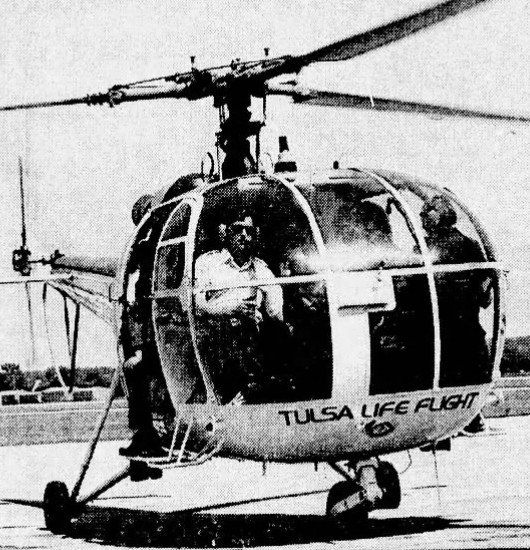
Tulsa Life Flight — 1979
Tulsa’s new Life Flight AStar during preparations for the beginning of regular operations in September 1979.
Tulsa World, September 9, 1979, p. 107
1979 — CareFlite
Methodist Hospitals of Dallas / Harris Hospital-Methodist — Dallas–Fort Worth, Texas
CareFlite began operations on October 1, 1979, as a cooperative helicopter medical service linking Methodist Hospitals of Dallas and Harris Hospital-Methodist in Fort Worth. The program was designed to provide rapid emergency and interhospital transportation throughout the Dallas–Fort Worth region and surrounding communities.
The service used a Bell 206L-1 LongRanger, with the helicopter rotating between the participating hospitals. Contemporary reporting described a service area extending approximately 150 miles from Dallas–Fort Worth, allowing patients in smaller communities to reach major medical centers much more quickly.
CareFlite was active almost immediately. Within days of its October 1 launch, the helicopter transported a patient from Cisco to a Houston hospital. Contemporary reporting from Wise County also documents CareFlite visiting outlying communities to demonstrate the new service to local medical and emergency personnel.
The program represented an early shared regional HEMS model, combining the resources of major metropolitan hospitals while extending advanced medical transportation well beyond their immediate communities.
Aircraft: CareFlite began operations with a Bell 206L-1 LongRanger, N27689. Contemporary launch-era photography confirms N27689 operating in CareFlite markings in September–October 1979.
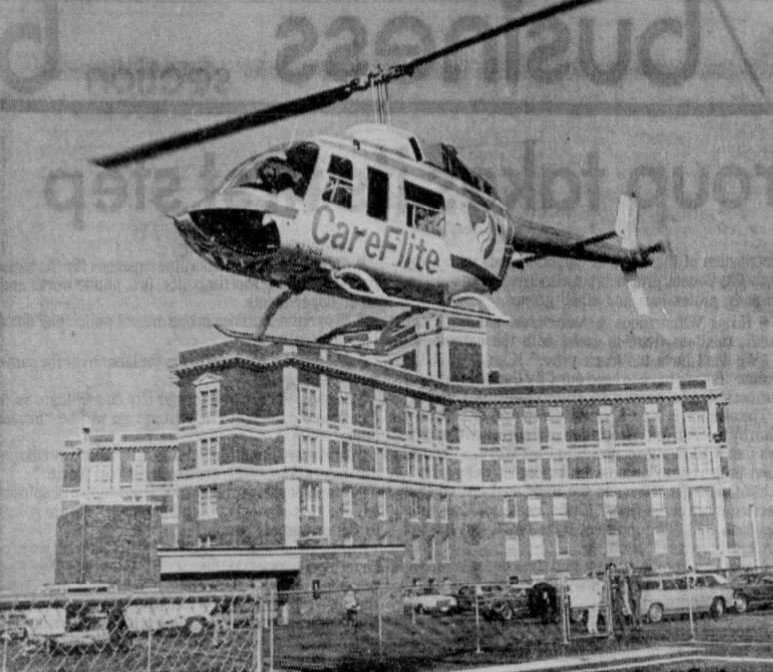
CareFlite — 1979
CareFlite’s Bell 206L-1 LongRanger during the program’s launch period in the Dallas–Fort Worth area.
Fort Worth Star-Telegram, September 28, 1979, p. 18
1980
1980 — Valley Hospital Flight for Life
Valley Hospital Medical Center — Las Vegas, Nevada
Flight for Life began helicopter medical operations at Valley Hospital Medical Center in Las Vegas in early 1980, providing emergency and interhospital transportation throughout southern Nevada and surrounding areas.
The program operated an Aérospatiale Alouette III supplied by Air West Helicopters, Inc. The aircraft was configured to carry two adult patients, two flight nurses, and a pilot, and was equipped to provide advanced medical care during transport.
Flight for Life was designed as a regional service extending beyond Las Vegas. By March 1980, the helicopter was visiting surrounding communities to introduce the program and its capabilities to local hospitals, emergency personnel, and law-enforcement agencies. A contemporary visit to St. George, Utah, documented the aircraft carrying prominent FLIGHT FOR LIFE markings.
Aircraft: Flight for Life operated an Aérospatiale Alouette III during its launch period. N9005D is a possible candidate for the early aircraft, but RotorPedia has not yet independently confirmed the registration.
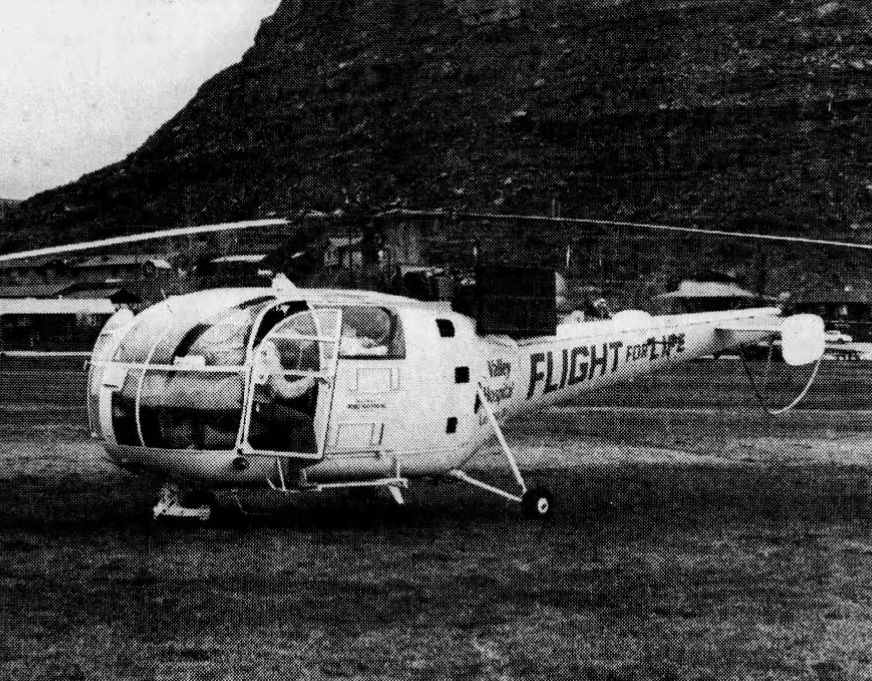
Valley Hospital Flight for Life — 1980
Valley Hospital Medical Center’s Flight for Life Alouette III during a March 1980 visit to St. George, Utah, introducing the regional service to local law-enforcement officers and residents.
Color Country Spectrum, March 12, 1980, p. 19
1980 — UCSD Life Flight
UCSD University Hospital Medical Center — San Diego, California
Life Flight began operations on March 17, 1980, sponsored by UCSD’s University Hospital Medical Center. Contemporary reporting described it as San Diego County’s first helicopter ambulance, developed after approximately a year of local and state planning and approved as an 18-month trial program.
The service operated a Bell 206L LongRanger II configured as a “miniature intensive care unit.” The helicopter carried two specially designed stretchers along with life-support, patient-monitoring and telemetry equipment. Based at UCSD Medical Center, the program maintained a round-the-clock operations center and was designed to be airborne within five minutes of receiving a request.
Life Flight functioned as a regional emergency medical system rather than simply an interhospital transport service. Hospitals, police, fire departments, sheriff’s offices, highway patrol, paramedics, lifeguards and other emergency agencies throughout San Diego and Imperial counties could contact the operations center directly. Patients could receive emergency treatment at the scene before being flown to the nearest appropriate facility among eight participating hospitals.
The flight crew included a pilot and specially trained flight nurse, with an emergency-room physician joining the crew on emergency missions. By early April, contemporary reporting documented Life Flight responding to accident scenes in the region.
Aircraft: Bell 206L LongRanger II, N10690 — confirmed launch-era aircraft. The helicopter was provided under UCSD Medical Center’s aviation contract with Evergreen Helicopters, Inc., which supplied the aircraft, pilots and maintenance support.
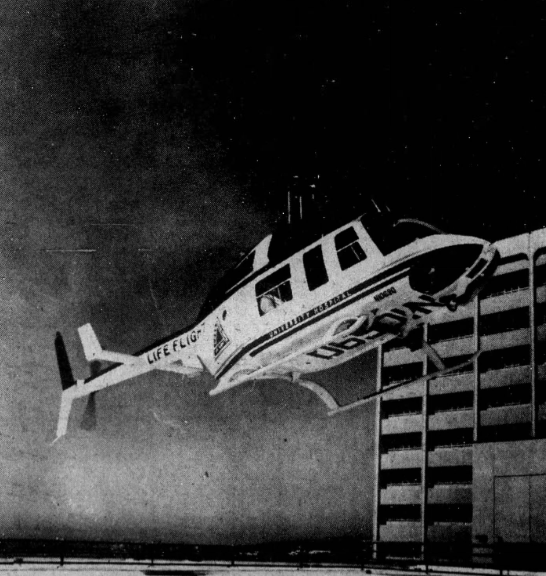
UCSD Life Flight — 1980
Life Flight’s Bell 206L LongRanger II, N206RM, departs its University Hospital base on a trial flight shortly before the service began operations on March 17, 1980.
Ramona Sentinel, March 6, 1980, p. 13
1980 — Baptist Life Flight
Baptist Medical Center — Jacksonville, Florida
Baptist Life Flight began operations on August 3, 1980, providing helicopter emergency medical transportation across Northeast Florida and Southeast Georgia. The regional service was based at Baptist Medical Center in Jacksonville and was developed to bring advanced medical care and rapid transportation to communities throughout the surrounding area. Pre-launch reporting confirms the planned August 3 start and regional role.
The program operated an Aérospatiale SA319B Alouette III through Rocky Mountain Helicopters. The medically equipped aircraft could accommodate two patients and was staffed by specially trained flight nurses, extending critical-care capabilities into the aircraft and to patients outside Jacksonville.
Life Flight was called into action almost immediately. On August 3, the program received its first request only minutes after officially going into service. The helicopter remained busy during its inaugural day, with contemporary photographs documenting both patient care in the field and transport to Baptist Medical Center. The following day’s Florida Times-Union described the service’s “busy debut.”
Aircraft: Aérospatiale SA319B Alouette III, N90825 — confirmed in Baptist Medical Center Life Flight service in 1980. Contemporary photography clearly shows N90825 carrying Baptist Medical Center markings. The available evidence does not yet establish that N90825 flew the program’s first mission on August 3.
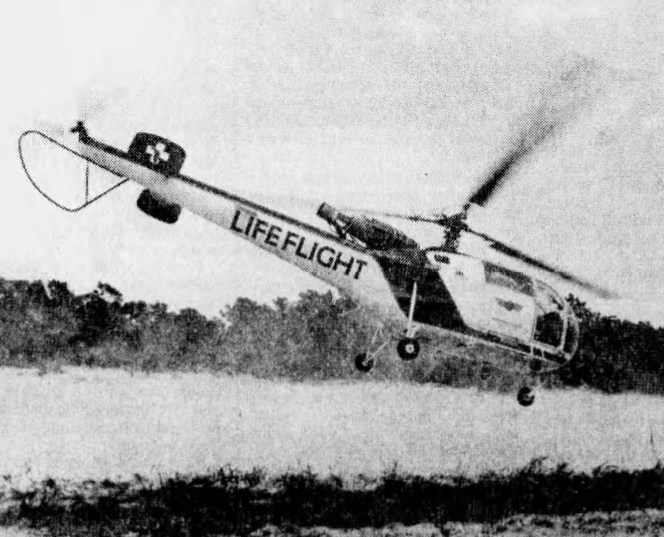
Baptist Life Flight — 1980
Baptist Medical Center’s Life Flight Alouette III transports a patient during the program’s first day of operation, August 3, 1980.
Florida Times-Union, August 4, 1980, p. 4
1980 — St. Mary’s Air Life
St. Mary’s Hospital — Grand Junction, Colorado
St. Mary’s Air Life began operations on September 1, 1980, bringing helicopter emergency medical transportation to Colorado’s Western Slope and surrounding areas. The service was designed primarily to reach critically ill or injured patients in locations where rapid ground transportation or fixed-wing aircraft were impractical, including remote communities, recreation areas and mining sites.
The program operated a Bell 206L LongRanger II owned and operated by Air Methods Inc. of Denver, with Monarch Aviation also contracted to provide aviation services. A pilot was stationed at St. Mary’s around the clock, while teams of nurses and paramedics provided medical care under the direction of St. Mary’s emergency-department physicians. The helicopter could carry two stretcher patients and was equipped as an airborne intensive-care unit with oxygen, cardiac monitoring and defibrillation, respiratory support, spinal immobilization, IV and intubation equipment, and emergency medications.
The new service was busy almost immediately. During its first week, contemporary reporting documented a Moab, Utah woman with a severe head injury being flown to St. Mary’s, an infant requiring specialized care being transported to Salt Lake City, and James Nation of Delta, Colorado, who nearly drowned in a canoe accident, being transferred to St. Mary’s intensive-care unit. By September 14, Air Life had completed 11 flights in its first 12 days.
The program also reflected substantial regional support. Contemporary reporting noted that Western Slope and eastern Utah energy and mining companies helped finance the approximately $600,000 helicopter, recognizing the need for rapid medical transportation in remote industrial areas.
Aircraft: Bell 206L LongRanger II, N3174S — strongly supported as the launch-era aircraft. Contemporary reporting confirms the LongRanger II and identifies Air Methods as its owner and operator. RotorPedia research strongly associates N3174S with St. Mary’s early Air Life operation, although the registration has not yet been verified in a readable launch-era photograph.
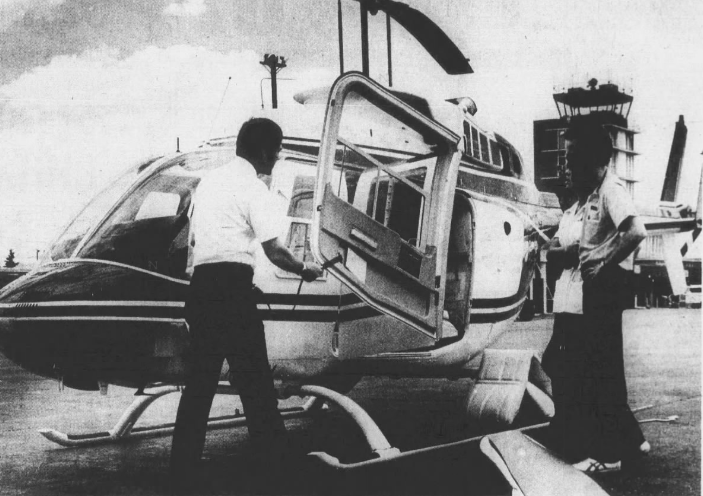
St. Mary’s Air Life — 1980
Pilot Roy Morgan and St. Mary’s staff members examine the new Bell LongRanger II shortly before Air Life began operations on September 1, 1980.
The Daily Sentinel, August 31, 1980, p. 11
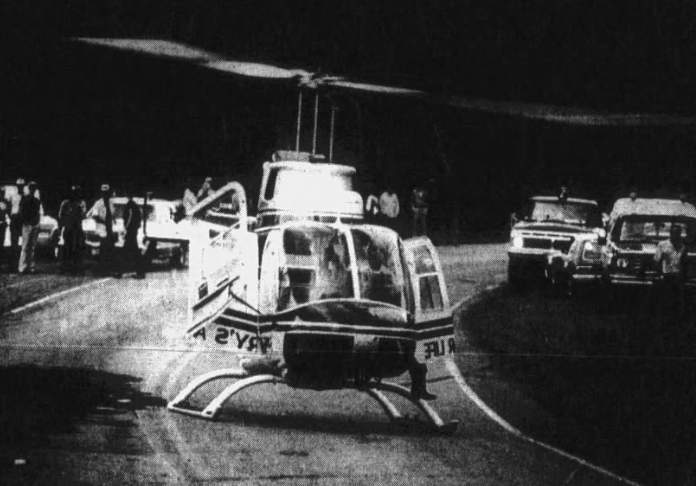
St. Mary’s Air Life — 1980
St. Mary’s Air Life helicopter lands on Grand Mesa during the program’s first weeks of operation. By September 14, the service had completed 11 flights in 12 days.
The Daily Sentinel, September 14, 1980, p. 11
1980 — Medi Flight Oklahoma
Oklahoma Memorial Hospital / Children’s Memorial Hospital — Oklahoma City, Oklahoma
Medi Flight Oklahoma began operations in October 1980, with a formal dedication marking the start of the new helicopter ambulance service on October 3. Based near Children’s Memorial Hospital, the program was designed to provide rapid emergency medical transportation within approximately a 150-mile radius of Oklahoma City.
The service was initially developed with a strong emphasis on transporting critically ill newborns to the Neonatal Intensive Care Unit at Children’s Memorial. Its mission quickly expanded, however, to include critically ill and injured children and adults, including trauma, automobile-accident and other emergency patients. By November, contemporary reporting described Medi Flight responding to emergencies well outside Oklahoma City.
The medical program was associated with Oklahoma Memorial Hospital and Children’s Memorial Hospital. Dr. Robert Wilder, head of the city hospitals’ emergency department, served as Medi Flight’s medical director. Betty Denwalt was chief flight nurse, and Ann Darling served as Medi Flight coordinator. Medical staffing included pediatric and neonatal nurses and respiratory therapists.
Contemporary reporting projected 300 to 400 transports during the program’s first year. The helicopter’s regional reach placed communities such as Pauls Valley, Guthrie and El Reno within its operating area, making Medi Flight an early example of a hospital-based helicopter service designed to extend specialized medical care well beyond its Oklahoma City base.
Aircraft and aviation operator: RotorPedia research indicates that the original Medi Flight aircraft and aviation services were commercially provided, with Lance Air Service strongly associated with the early operation. However, the exact launch aircraft, registration and original aviation-provider arrangement have not yet been independently confirmed. A subsequent competitive contract for aviation services was awarded to Air Transport Service Inc. in March 1981.
1980 — Billings Deaconess Lifeline
Billings Deaconess Hospital — Billings, Montana
Lifeline began emergency helicopter operations at Billings Deaconess Hospital on December 2, 1980. The hospital’s new helicopter had arrived the previous day for crew familiarization and training, but before that training was complete, Deaconess received an emergency request involving a critically ill cardiac patient in Big Timber, Montana. Two members of the hospital’s advanced-life-support team flew to Big Timber and returned the patient to Deaconess, making it Lifeline’s first emergency patient mission.
The program operated an Aérospatiale Alouette III supplied by Evergreen Flying Service of McMinnville, Oregon. The aircraft was based at Deaconess, with the aviation contract providing pilots and maintenance support while hospital medical personnel provided advanced patient care aboard the helicopter. Lifeline quickly developed a regional role, transporting patients from communities well beyond Billings.
Lifeline entered service during an unusual period of competition between Billings’ two major hospitals. Deaconess and St. Vincent Hospital each operated separate helicopter ambulance services, an arrangement both hospitals acknowledged was a costly duplication. Deaconess contracted with Evergreen for its Alouette III, while St. Vincent resumed its HELP Flight operation with a larger Bell LongRanger following the August 1980 loss of its previous helicopter.
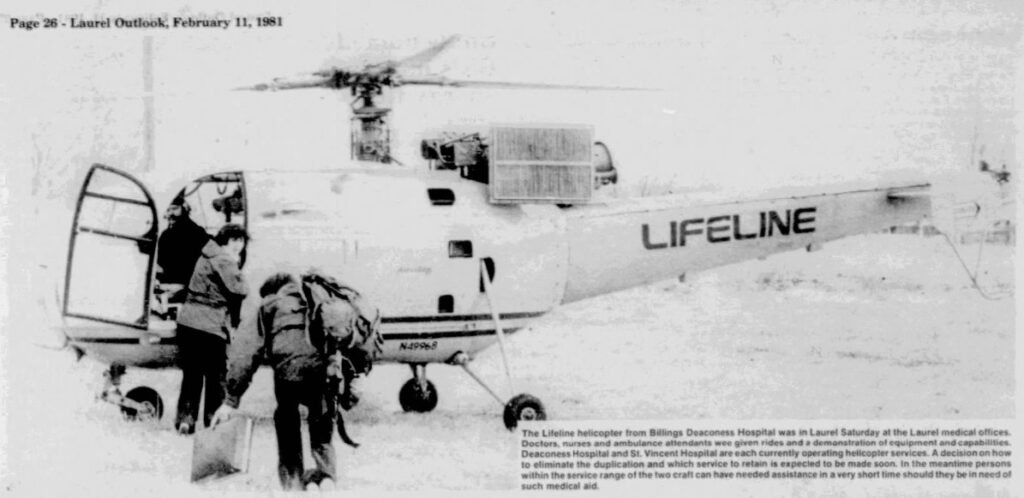
Billings Deaconess Lifeline — 1981
Billings Deaconess Hospital’s Lifeline Alouette III, N49968, during a medical demonstration in Laurel, Montana. The aircraft had entered service at Deaconess in December 1980.
Laurel Outlook, February 11, 1981, p. 26
By early 1981, Lifeline was conducting long-distance patient transports throughout the region. One documented February mission transported a 77-year-old cardiac patient from Marmarth, North Dakota, to Billings, demonstrating the geographic reach the service had developed within only a few months.
The period of competing helicopter services proved brief. In March 1981, Deaconess announced that it would discontinue Lifeline as the hospitals pursued a more integrated regional emergency-transport system and sought to eliminate duplication of costly helicopter services. Deaconess planned to terminate Lifeline by April 1, 1981, leaving St. Vincent’s HELP Flight as the helicopter ambulance service in Billings. Deaconess continued its ground-based mobile intensive-care and fixed-wing air-ambulance programs and planned to use St. Vincent’s helicopter when its patients required helicopter transport.
Aircraft: Aérospatiale Alouette III, N49968 — confirmed. Contemporary photography clearly shows N49968 carrying LIFELINE markings while operating for Billings Deaconess Hospital. Supplied through Evergreen Flying Service, the aircraft’s brief Billings assignment ended in spring 1981. N49968 subsequently moved to Pennsylvania, where it became the first aircraft operated by Geisinger Life Flight.
1981
1981 — Carraway Methodist Life Saver I
Carraway Methodist Medical Center — Birmingham, Alabama
Carraway Methodist Medical Center unveiled Life Saver I on November 17, 1980, describing the helicopter as an “intensive care unit in the air.” The service officially began operations January 2, 1981, providing emergency and interhospital transport within a 150-mile radius of Birmingham.
Life Saver I was staffed primarily by registered nurses, with physicians and surgeons joining missions when needed. Calls were coordinated through Carraway’s communications center and could come from hospitals, law enforcement, paramedics, ambulance services and other rescue agencies.
The program became active immediately. By January 9, Carraway had received five calls since beginning service, including an early mission transporting 76-year-old Victoria Johnson from Chilton Memorial Hospital in Clanton to Carraway for cardiac care.
Aircraft: Bell 206L LongRanger II, N5745A — confirmed. Contemporary reporting consistently describes Life Saver I as Carraway’s own hospital helicopter, and later records identify Carraway as a helicopter operator. Available evidence therefore suggests Carraway Methodist operated the aircraft directly rather than contracting with one of the major commercial HEMS operators, although the original ownership/operating arrangement has not been definitively confirmed.
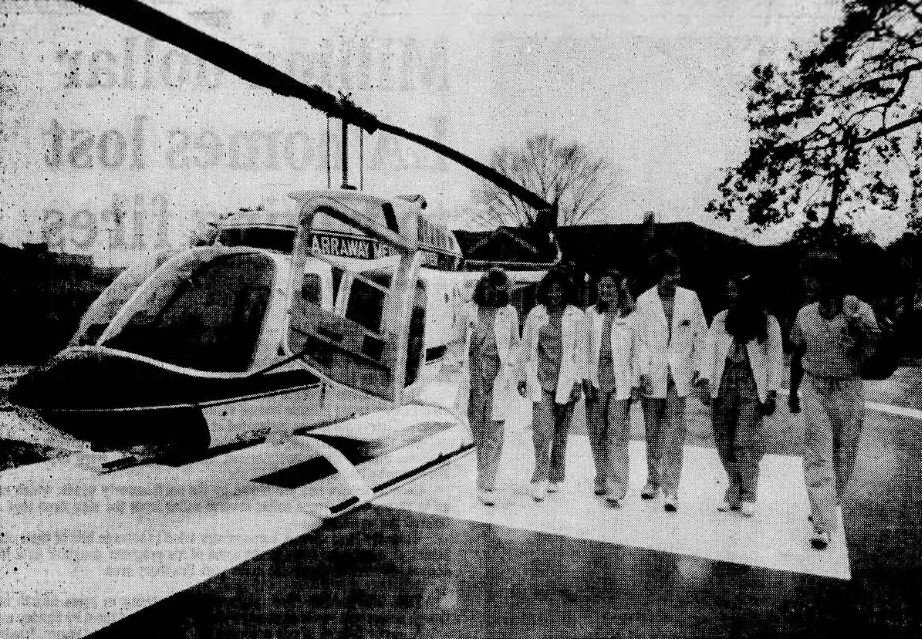
Carraway Life Saver I — 1980
Carraway Methodist Medical Center’s original Life Saver I flight nurses with Bell 206L LongRanger II N5745A shortly before the program entered service. Life Saver I was unveiled November 17, 1980, and began operations January 2, 1981.
The Birmingham News, November 17, 1980, p. 2
1981 — Life-Guard of America / Life-Guard 10
Lewis-Gale Hospital — Salem, Virginia
Life-Guard of America established a regional helicopter ambulance service at Lewis-Gale Hospital in late January 1981. The program was headed by Dr. Richard H. Fisher, an orthopedic surgeon at Lewis-Gale Clinic.
Operating as Life-Guard 10, the helicopter served a 120-nautical-mile radius around the Roanoke Valley, extending across southwestern Virginia and into portions of West Virginia and North Carolina. The aircraft could accommodate two patients and carried oxygen, suction, cardiac monitoring and other emergency medical equipment. By February, Life-Guard 10 was being introduced to hospitals throughout the region.
Aircraft: Bell 206B JetRanger III, N57588 — confirmed. Contemporary photographs clearly show both the LIFE-GUARD 10 markings and registration N57588.
The exact operational start date has not yet been confirmed; contemporary reporting on January 7 stated that service was scheduled to begin later that month.
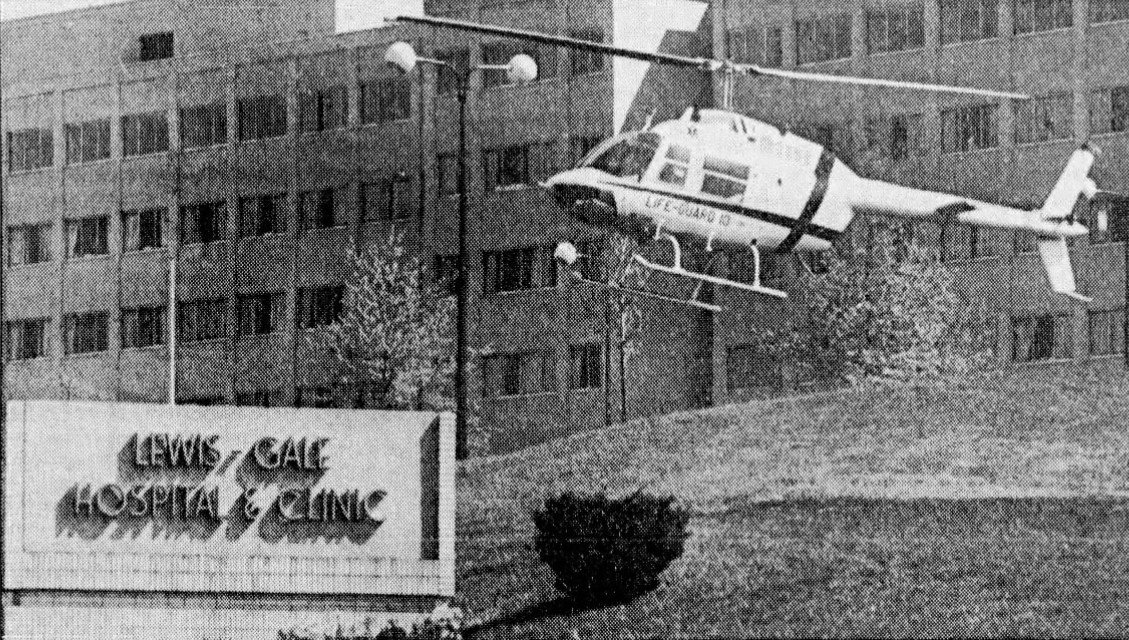
Life-Guard 10 — 1981
Life-Guard 10 at Lewis-Gale Hospital in Salem, Virginia. The Bell 206B JetRanger III, N57588, provided regional helicopter ambulance service from Lewis-Gale in early 1981.
The Roanoke Times, May 4, 1981, p. 9
1981 — St. Patrick Hospital Life Flight
St. Patrick Hospital — Missoula, Montana
St. Patrick Hospital began its Life Flight helicopter ambulance service in March 1981, providing around-the-clock emergency medical transport from Missoula. The hospital operated the program through a lease arrangement with Mountain West Helicopters, which supplied the aircraft and pilots.
Life Flight normally carried a pilot and registered nurse and could accommodate approximately two patients. Three pilots and seven nurses staffed the program, allowing a crew to be airborne within seven minutes of an emergency call. The service covered a broad region surrounding Missoula, handling both hospital transfers and accident-scene responses. By June, Life Flight had already transported 28 patients, with approximately 40 percent of its missions involving responses directly to accident or injury scenes.
The helicopter functioned as a mobile critical-care unit, carrying cardiac monitoring, emergency medications, oxygen and other equipment. Early missions included cardiac patients, an overdose victim in Hamilton and a woman from Salmon, Idaho, who suffered a serious head injury after falling from a horse.
Aircraft: Bell 206B JetRanger, N5011G — confirmed. The aircraft was operated by Mountain West Helicopters, St. Patrick’s contracted aviation provider.
The exact March 1981 operational start date has not been located in the available contemporary reporting.
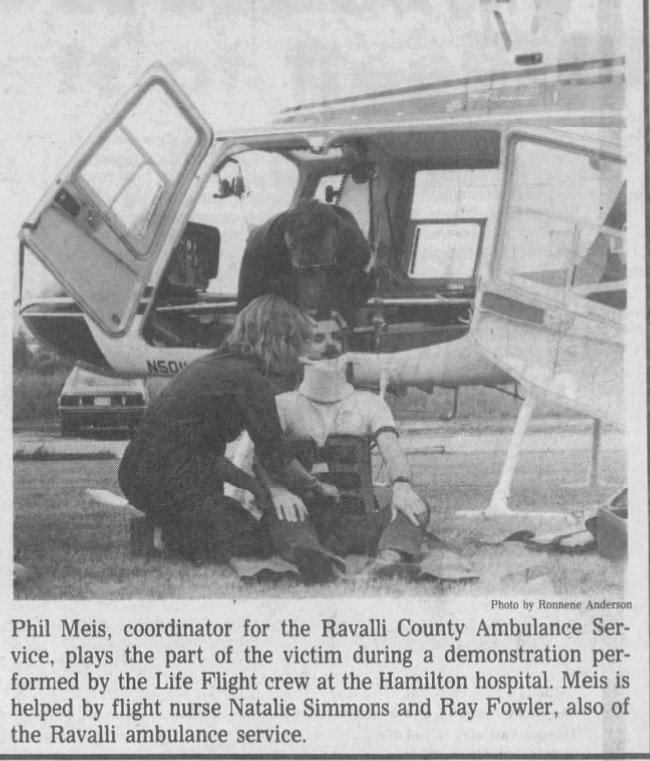
St. Patrick Hospital Life Flight — 1981
St. Patrick Hospital Life Flight demonstrates emergency patient care at Marcus Daly Memorial Hospital in Hamilton, Montana. Flight nurse Natalie Simmons and Ray Fowler assist during the exercise.
The Missoulian, June 11, 1981, p. 34
1981 — Allentown & Sacred Heart MedEvac
Allentown & Sacred Heart Hospital Center — Allentown, Pennsylvania
The Allentown & Sacred Heart Hospital Center began its interim helicopter transfer program on May 5, 1981, when 24-year-old accident victim Rodney Everett became the program’s first patient. Everett was flown from Palmerton Hospital to the Hospital Center for specialized trauma care. The new service initially focused on transporting critically injured burn and Class I trauma patients between hospitals.
The program operated under an unusual arrangement. Rather than being based at the hospital, the helicopter was leased through Keystone Helicopter Corporation and stationed at Limerick Airport, approximately 15 minutes away by air. When a transfer was requested, the helicopter flew first to A&SHHC to pick up a surgical resident and flight-trained nurse, then continued to the referring hospital and returned with the patient. Twenty emergency-room registered nurses received specialized flight training for the program.
The aircraft was an MBB BO 105, a German-built twin-engine helicopter capable of carrying two patients and cruising at approximately 130 mph. Medical equipment included oxygen, suction, ECG monitoring, MAST trousers and spinal immobilization equipment. The initial program was strictly interhospital; approval to base the helicopter at A&SHHC and begin accident-scene responses was still being pursued.
Aircraft: MBB BO 105 — confirmed. Registration N205BB — confirmed through firsthand recollection, with photographic or contemporary documentary verification still being sought. The twin-engine BO 105 was configured to carry two patients and was equipped for critical-care transport, including oxygen, suction, cardiac monitoring, MAST equipment and spinal immobilization. The helicopter was initially based at Limerick Airport and supplied through Keystone Helicopter Corporation.
The "31st" Program Claim
A&SHHC reported in May 1981 that 34 helicopter transfer programs were then established nationwide, of which 30 were interhospital-transfer programs similar to its interim service. This contemporary count appears to provide the basis for the later description of MedEvac as the nation’s “31st” such program. RotorPedia treats this as a contemporary program claim rather than an independently verified national ranking.
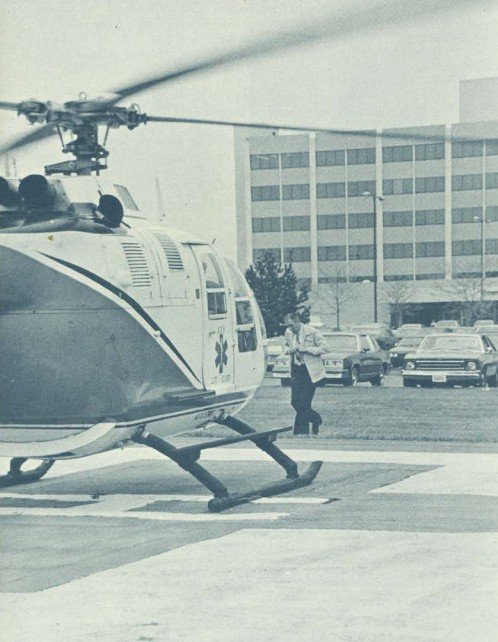
Allentown & Sacred Heart MedEvac — 1981
The MBB BO 105 used for the new interhospital helicopter transfer program at Allentown & Sacred Heart Hospital Center. The program’s first patient was transported from Palmerton Hospital on May 5, 1981.
A&SHHC Update, May 18, 1981
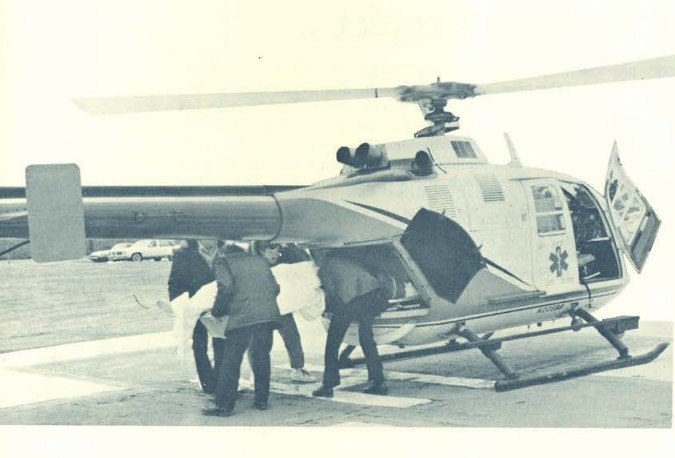
MedEvac — 1982
The MedEvac helicopter at Allentown & Sacred Heart Hospital Center as the hospital prepared to expand the program to include accident-scene response and permanently base the aircraft at the Hospital Center.
A&SHHC Update, February 22, 1982
1981 — Geisinger Life Flight
Geisinger Medical Center — Danville, Pennsylvania
Geisinger Medical Center’s original Life Flight helicopter arrived in Danville on May 1, 1981, beginning two months of crew training and preparation before the program’s formal launch. The aircraft was an Aérospatiale SA316B Alouette III, N49968, leased from Evergreen Helicopters. Life Flight was designed as a regional critical-care response system, capable of transporting patients to Geisinger or other medical centers depending on the care they required.
Although the program was not yet officially in service, Life Flight made its first official call on May 28, 1981. While the helicopter was in the Williamsport area for a demonstration, it was requested for a tractor-trailer crash near Milton. The crew transported critically injured driver Dwight A. Wilson to Williamsport Hospital in approximately six minutes. Contemporary reporting emphasized that the aircraft was still in its training period and not yet fully equipped for routine emergency response.
Life Flight formally entered service on July 1, 1981, when Geisinger dedicated the new program and emergency department. At 4:10 p.m. that afternoon, its first patient was five-year-old Mitchell Snyder, who had been seriously injured in a lawn-mower accident at his family’s farm near Pitman, Pennsylvania. Pilot John McLeod, a flight nurse and an emergency physician were airborne within five minutes. The flight from Danville to Pitman took approximately 11 minutes, and Snyder was in a Geisinger operating room less than half an hour after the accident.
From the beginning, Geisinger emphasized that Life Flight was not intended to replace or compete with local ambulance services. Instead, the helicopter extended the region’s emergency medical system, allowing critically ill or injured patients to reach specialized care without tying up community ambulances on lengthy transfers. The program could respond to accident scenes, transfer patients between hospitals and transport patients to Geisinger or another medical center, depending on the care required. Life Flight was also envisioned for specialized missions such as transporting organs for transplantation.
The original aviation team supplied by Evergreen Helicopters consisted of just three people: pilots John McLeod and Martin “Duane” Dillingham, and mechanic Rich Beers. At Geisinger, Dr. Thomas Royer was a key medical and administrative leader in establishing Life Flight, while vice president and project supervisor Jim Smith helped develop and introduce the new regional system. At the July dedication, Royer emphasized that Life Flight was the product of a team effort, rather than the work of any one individual.
Aircraft: Aérospatiale SA316B Alouette III, N49968 — confirmed. The aircraft had previously served with Billings Deaconess Lifeline in Montana before arriving at Geisinger on May 1, creating a direct aircraft connection between two of the early hospital-based helicopter programs.
The "28th" Program Claim
A 1986 Press-Enterprise retrospective reported that when Geisinger Medical Center established Life Flight in 1981, it became the “28th such program in the country.” The figure was attributed to Life Flight program director Dr. Michael J. Leicht.
RotorPedia’s broader historical reconstruction identifies additional earlier helicopter medical services that may not have met the definition used for this contemporary ranking. The 28th designation is therefore preserved as a historical claim rather than an independently verified national ranking.
Source: Press-Enterprise, July 14, 1986
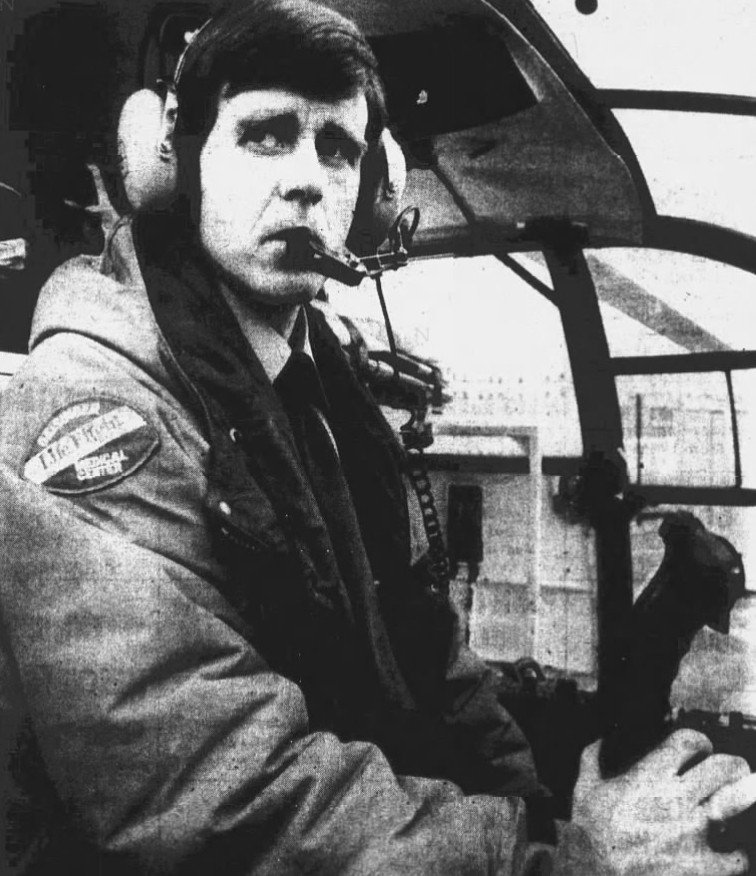
John McLeod — Geisinger Life Flight Pilot
John McLeod, one of Geisinger Life Flight’s two original pilots, at the controls of the Life Flight Alouette III. McLeod and Martin “Duane” Dillingham were the program’s original pilots, working for Evergreen Helicopters.
The Morning Press, February 18, 1983, p. 99
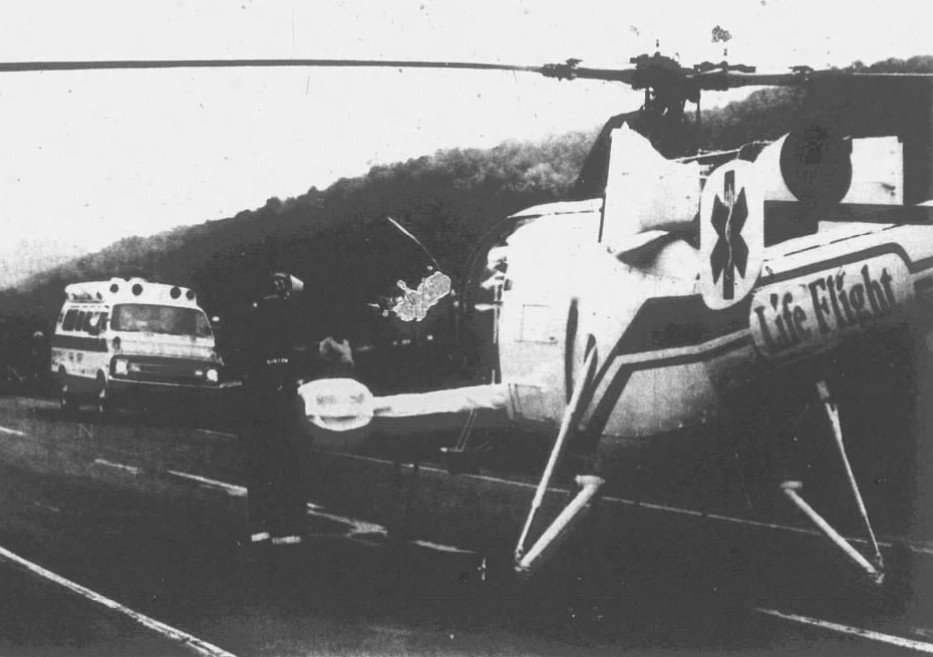
Geisinger Life Flight’s First Official Call — 1981
Geisinger Life Flight at the scene of a tractor-trailer crash near Milton on May 28, 1981. Although the program was still in its pre-launch training period, the crew responded and transported critically injured driver Dwight A. Wilson to Williamsport Hospital. Life Flight formally entered service on July 1.
The Daily Item, May 29, 1981, p. 19
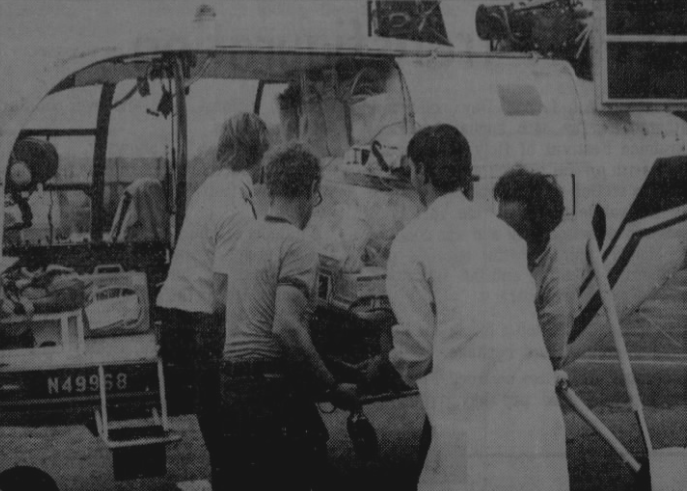
Infant Airlifted to Geisinger — September 1981
A one-day-old infant requiring specialized care is transferred to the Geisinger Life Flight Alouette III, N49968, at Larksville, Pennsylvania. The infant was transported by Larksville Ambulance to Mercy Hospital, where the Geisinger medical crew placed the patient in a portable incubator for the flight to Geisinger Medical Center in Danville. Pictured are pilot Duane Dillingham; James Millner Jr., Larksville ambulance driver; Dr. Bruce Tilton, physician; and Joseph Caffrey, ambulance attendant. Flight nurses Gail Orek and Cindy Adams, along with Henry Odell, Larksville ambulance attendant, also assisted.
Citizens’ Voice, September 8, 1981, p. 9
THE EARLY HEMS INDUSTRY - BY 1981
By July 1981, a small group of specialized helicopter companies was helping transform hospital-based air medical transport into a national industry. Rocky Mountain Helicopters and its Aviation Medical Services operation emerged as the leading commercial provider, while companies including Evergreen, Air West, Mountain West and Air Methods also became important participants.
Aircraft choices were even more concentrated. In RotorPedia’s reconstruction of the first 38 programs through July 1, 1981, 16 launched with an Alouette III and 11 with a Bell 206-family helicopter. Together, the two aircraft families accounted for approximately 71% of the program launches identified in this study.
The Alouette III defined much of the first generation of hospital HEMS, while the Bell 206 family became increasingly prominent as the industry entered the 1980s. Newer designs such as the AS350 AStar and MBB BO 105 were beginning to signal the next generation of air-medical aircraft.
Closing Section
By 1981 — A National Model Had Emerged
By the end of 1981, civilian helicopter EMS had evolved from a handful of experimental and regional services into a rapidly expanding network of hospital-sponsored and cooperative air medical programs across the United States.
No single model prevailed. Some hospitals operated programs with commercial aviation partners, others shared helicopters regionally, and private services worked closely with multiple hospitals. Aircraft ranged from the Alouette III and Bell 206 family to newer designs such as the AS350 AStar and MBB BO105.
The programs documented in this chronology helped establish many of the operational and medical concepts that would shape the rapid expansion of helicopter EMS during the 1980s.
RotorPedia’s reconstruction currently ends with the programs documented through 1981. As additional contemporary evidence is located, dates, aircraft identifications, and other details may be refined.